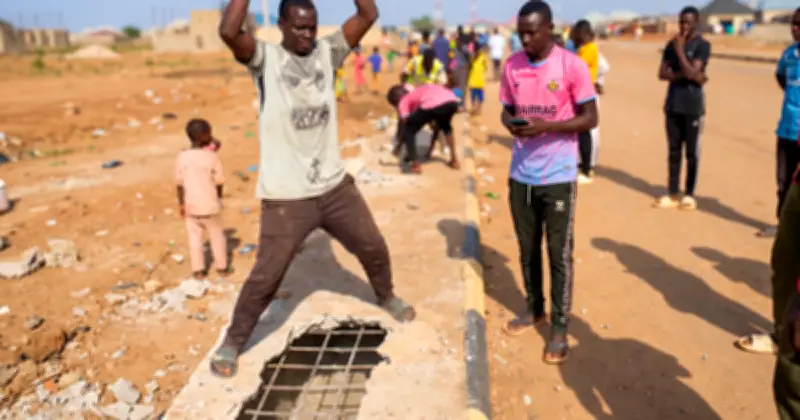
A viral video shows a young man repeatedly breaking a road drainage structure, apparently to remove the iron rods inside it, renewing concerns over Nigeria's growing “iron condemned” scrap trade and the vandalism of public infrastructure.
The footage, shared on X by user Oseni Rufai (@ruffydfire) on August 23, 2026, depicts the man using a brick to break through the concrete while another person stands nearby. Several people are visible in the background watching as he continues.
The man's identity, the location of the road project, and when the video was recorded could not be independently verified. However, the incident mirrors recent cases of scavengers damaging bridges, road barriers, and other public structures to remove metals for sale.
Scavengers Target Bridges and Road Structures in Lagos
In Nigeria, scrap-metal pickers are commonly known as “iron condemned” scavengers. While many make a living by collecting discarded metal, recent reports show that some have moved beyond picking up waste and are now breaking into functioning structures to get valuable iron and steel.
A PUNCH investigation published on Sunday found scavengers targeting bridges, old buildings, construction sites, and even occupied homes in Lagos for materials that can be sold as scrap. The latest video comes shortly after the vandalism of the Festac-Alakija Bridge in Lagos, where suspected vandals allegedly broke into parts of the bridge to remove iron rods and other steel reinforcement. The incident led to the arrest of 27 suspects and raised fresh concerns about the safety of public infrastructure.
Lagos Commissioner for Environment and Water Resources Tokunbo Wahab said investigators found that iron rods, steel reinforcement, cables, and other important components had been removed from the bridge. Governor Babajide Sanwo-Olu later inspected the bridge and said it remained safe for use. He also warned that those involved in vandalising public infrastructure would face the law.
Officials Warn of Safety Risks and Call for Community Support
The Festac-Alakija incident was followed by reports of scavengers removing iron rods from concrete road barriers around Mile 12, showing that vandals are also targeting smaller road structures for metals that can be sold. Nigeria's public infrastructure has increasingly come under threat from scavengers removing iron rods and other metals for scrap.
The Federal Minister of Works, David Umahi, has described the vandalism of road infrastructure as “devilish”, “wicked”, and unacceptable. Speaking in Lagos, he called on residents to help protect public assets, noting that the government cannot monitor every road, bridge, and construction site without support from local communities.
The concern goes beyond the value of the stolen metal. Removing reinforcement from concrete structures can weaken them, especially when the affected rods form part of a bridge or another important structural component. The Lagos State Government has therefore described the Festac-Alakija vandalism as a public safety concern. Damage to road drainage can also leave communities with costly repairs and potentially cause severe flooding during heavy rainfall.
Public Outcry and the Role of Scrap Dealers
Many Nigerians who have reacted to the latest video have described the act as self-sabotage, arguing that the roads, bridges, and drainage systems being damaged are ultimately meant to serve the same communities where the vandalism occurs. At the same time, poverty and unemployment are often cited as factors driving people into informal work, including scrap collection.
Collecting discarded metal is not itself a crime. The concern arises when people deliberately destroy functioning infrastructure to obtain materials they can sell. That has also raised questions about the buyers and dealers who provide a market for stolen materials. Tackling infrastructure vandalism therefore involves not only those caught removing the metal, but also the wider network through which the materials are bought and resold.
As authorities continue to arrest suspected vandals and investigate cases involving damaged bridges, roads, and other public assets, the footage is likely to add to calls for closer monitoring of the scrap-metal trade and stronger action against those profiting from stolen infrastructure.