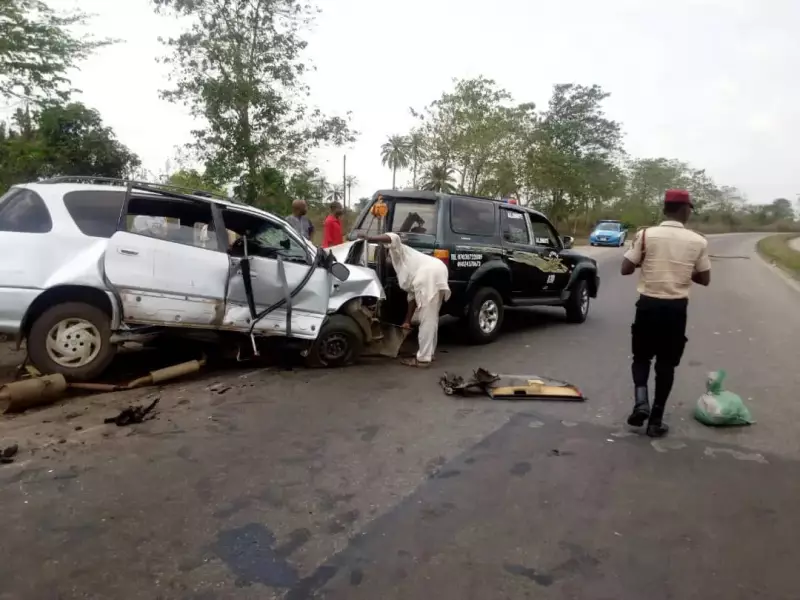
Transportation experts have issued a stark warning: Nigeria's perilous highways require far more than public awareness campaigns and slogans to become safe. From the bustling Lagos–Ibadan Expressway to the treacherous Jos–Makurdi corridor, the nation's roads continue to be killing fields, claiming thousands of lives annually in preventable accidents.
The Grim Statistics of a National Crisis
Despite the visible presence of the Federal Road Safety Corps (FRSC) and years of policy promises, the death toll remains catastrophically high. The World Health Organisation (WHO) estimated that over 41,000 Nigerians die each year from road crashes, placing the country among the global leaders in road traffic fatalities.
Official data from the FRSC paints a similarly alarming picture. Its report for the first quarter of 2025 documented 2,650 road crashes, resulting in 1,593 deaths and 9,298 injuries. The full-year figures for 2024 showed at least 5,421 fatalities, a seven per cent increase from the 5,081 deaths recorded in 2023. This rise occurred even as the total number of crashes fell by 10 per cent, indicating accidents are becoming more deadly.
The FRSC attributes the carnage to a cocktail of human errors: over-speeding, wrongful overtaking, driving against traffic, fatigue, and substance abuse. Secondary factors like potholes, collapsed bridges, missing signs, and insecurity compound the problem. A tragic example was the scooping of fuel from fallen tankers, which alone claimed 411 lives in 2024.
Systemic Failures and Faded Initiatives
Transport analyst Olawunmi Bamidele critiqued the FRSC's approach, noting that many past initiatives—like speed limiters, alcolysers, and radar guns—have faded without making a lasting impact. He alleged that enforcement now often prioritises revenue generation over genuine safety prevention.
"FRSC alone cannot fix Nigeria’s broken road safety culture, but the corps too must first regain public trust," Bamidele stated. "Many of the punitive measures are geared towards revenue generation rather than preventive measures. We need a proper re-orientation across the board."
The high-profile accident involving boxing champion Anthony Joshua on the Lagos-Ibadan Expressway in December 2025 underscored the dangers. The conflicting official reports—citing wrong overtaking, a tyre burst, or brake failure—highlighted the lack of reliable investigation and transparency, a point stressed by experts.
Beyond Campaigns: The Call for Evidence-Based Solutions
Dr. Emmanuel Mogaji, a transportation and consumer behaviour expert, warned that advances in vehicle technology do not guarantee safety on Nigeria's unpredictable roads. "Even the most sophisticated car cannot compensate for a bad road," he said, emphasising the critical role of driver behaviour and training.
He advocated for the deployment of technology like speed cameras and automated number plate recognition, tools proven effective elsewhere but scarce in Nigeria. Mobility expert Luqman Mamudu echoed this, stressing that discourse on over-speeding must be evidence-based, not speculative, in the absence of widespread speed-detection infrastructure.
Mamudu, a former director at the National Automotive Design and Development Council, called for deeper structural reforms. These include a ban on parking on expressways, rapid clearance of breakdowns, and strict control of convoy movements and sirens. "Nigeria’s highways are not designed for convoy-induced speeding," he warned.
Patrick Adenusi of Safety Beyond Borders described Nigeria's road system as "a perfect storm" where human error meets infrastructure neglect and weak oversight. The consensus is clear: stopping the bloodshed on Nigerian highways demands moving beyond mere campaigns to a holistic, enforced, and technology-driven strategy that addresses root causes from bad roads to bad driving.