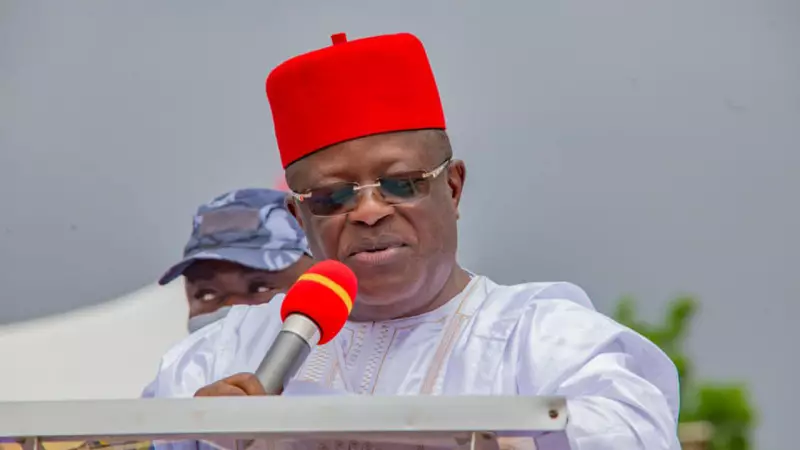
The Federal Government has officially launched a sophisticated Closed-Circuit Television (CCTV) monitoring centre for the Third Mainland Bridge in Lagos, marking a significant upgrade in safety and surveillance infrastructure for the critical transport link.
A New Era of Surveillance and Safety
Commissioned by the Minister of Works, Engr David Umahi, on January 11, 2026, the new facility is a direct response to President Bola Tinubu's directive to rehabilitate and secure vital federal bridges nationwide. The centre is equipped with high-definition CCTV cameras that monitor both the bridge deck and its underwater sections. To support operations, the government has provided a dedicated surveillance boat and two operational Hilux vehicles for rapid deployment.
Umahi highlighted that the administration inherited the Third Mainland, Carter, and Iddo Bridges in a "very terrible state" in 2023, with severe defects on surfaces, expansion joints, and structural elements. Following a comprehensive re-evaluation, the government undertook total rehabilitation, which has now been successfully completed and commissioned.
Operational Mandate and Nationwide Directives
The minister outlined the core objectives of the new surveillance system: to control speeding, prevent traffic obstructions, curb vehicle fires, and deter suicide attempts on the bridge. The system enables real-time monitoring, with designated lay-bys allowing enforcement without disrupting traffic flow. The Nigeria Police will be responsible for setting and enforcing speed limits, backed by the new infrastructure, patrol vehicles, and boats.
Umahi also announced that a third phase of the project, extending bridge works to Falomo and Agbongbo, is nearing completion. He directed contractors to proceed immediately with painting and road markings on finished sections, targeting commissioning of the extension before the end of January.
Beyond Lagos, the minister issued sweeping directives on national road construction standards. He declared that laying stone base without pavers is no longer permitted, mandating that all stone bases must be laid wet, mixed with cement, and compacted with pavers. Furthermore, road shoulders must now be constructed with concrete instead of asphalt for improved durability.
Accountability, Warnings, and Legal Action
Umahi disclosed a major reorganisation within the Ministry of Works, assigning directors, deputy directors, and engineers to take direct responsibility for specific projects. He warned that non-performing staff would face sanctions, stressing strict accountability.
On Lagos matters, the minister ordered an immediate halt to all concessions and allocations of federal road assets in the state due to observed malpractices. He directed that future decisions must involve the Lagos State Government and be based on proper evaluations.
Umahi issued a seven-day ultimatum to individuals involved in illegal sand mining that damaged a bridge pier on the Third Mainland Bridge, ordering them to remove equipment and pay for repairs or face arrest. He also revealed plans to initiate defamation lawsuits against Winhomes CEO, Stella Ifeoma Okengwu, for allegations of bribery concerning the Lagos Coastal Highway project. Umahi insisted the road's alignment was changed on technical grounds to avoid critical submarine cables, in line with presidential directives, and cautioned media against unverified reporting.
Technical Specifications and Project Cost
At the commissioning, the Federal Controller of Works in Lagos, Engineer Olufemi Dare, detailed the advanced technology. He stated the system is designed to enable rescue and response operations within two to three minutes of any incident, setting a new benchmark for bridge safety in Nigeria. The centre is powered by renewable energy, utilizing 240 solar panels to supply the fully air-conditioned facility.
Supporting infrastructure includes 10 inverters, 16 inverter batteries, a 300kVA transformer, a standby generating plant, borehole water supply, and a rooftop terrace. The broader works also involved installing 1,268 solar-powered streetlights.
Dare provided the financial details, stating the total contract sum is N43,118,028,778, with N36,295,371,37 already disbursed to the contractor. He clarified this event marks the first phase of commissioning, with a full commissioning including the bridge extension to follow later.
Umahi concluded by reaffirming the administration's commitment to durable infrastructure, safety, and accountability, aligning the initiatives with President Tinubu's vision to reset Nigeria's road network and spur national development.