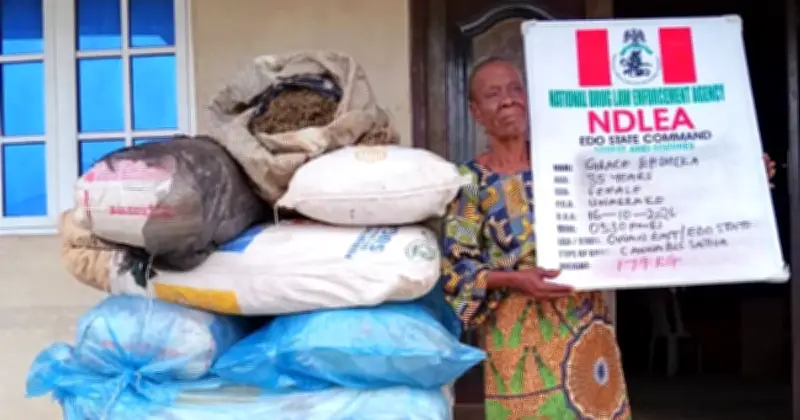
The National Drug Law Enforcement Agency (NDLEA) arrested 85-year-old Grace Ehimeka, also known as Mama Grace, at her home in Warake community, Edo State, on October 16, 2026, recovering 15 bags of cannabis weighing 179kg. Ehimeka told investigators that she had been selling the substance for more than two years because she struggled to survive as a widow, and she pleaded with officers to give her another chance.
Arrest and Recovery in Edo State
According to the NDLEA's Edo State Commander, Mitchell Ofoyeju, operatives conducted coordinated raids that led to Ehimeka's arrest along with five other suspects: Ali Garba, 57; Habib Braimoh, 45; Musa Mubid, 35; Ayo Aigberadion, 53; and Hope Okoro, 35. The agency reported that all suspects were taken into custody during the operation.
Ehimeka's statement to investigators highlighted her financial desperation. “I am a widow and started selling cannabis over two years ago just to survive. My family members have warned me to stop, but I kept postponing my decision to stop. Officers, if you give me another chance, I will never sell cannabis again,” she said.
Pattern of Elderly Arrests Raises Concerns
Ehimeka's case is not isolated. In August 2026, the NDLEA arrested 101-year-old Esther Ogunmabo in Ilisan, Ogun State, with 90g of skunk wrapped in fufu. Ogunmabo told investigators she turned to selling the substance after a fire destroyed her provisions shop. In October 2026, 83-year-old Uloma Uchechi Sunday was rearrested in Abia State, months after she and her daughter were convicted of drug-related offences; the NDLEA said she had paid a court-imposed fine and returned to the alleged trade.
Earlier, in May 2025, the agency arrested 80-year-old Ayuba Ashiru in Kaduna State, who had previously served a 10-year prison term for drug dealing and was found with 2.3kg of cannabis. In April 2026, 83-year-old shoemaker Pa John Ofiel was arrested in Abia State with 700g of cannabis, and 78-year-old Ogunjobi Samuel was arrested in Ekiti State with 350g of the substance, according to the NDLEA.
Financial Hardship and Elderly Welfare
In a special feature published on Punch, Victor Ayeni explained that “senior citizens are increasingly engaging in offences such as drug trafficking, child sexual abuse, and acting as accessories or shields for criminal syndicates.” He attributed this to their perceived trustworthiness and lower likelihood of rigorous security screening, but primarily to financial hardship. “Many elderly citizens are also experiencing the effects of the economic downturn. Many of us are retirees or pensioners. Look at how the country is treating senior citizens who spent decades working for the country and living upright. Some older people feel that being upright hasn’t paid off.”
On October 14, retired police officers protested at the National Assembly in Abuja, demanding that President Bola Tinubu sign a bill to remove police personnel from the Contributory Pension Scheme. The retirees complained that inadequate pension payments and rising living costs made it difficult to afford necessities, highlighting broader questions about how older Nigerians can meet their needs when income is insufficient.
Questions of Accountability and Support
These cases do not establish that elderly drug trafficking is increasing nationwide or that financial hardship directly drives elderly people into drug dealing. However, they raise questions about the circumstances behind individual arrests, the effectiveness of penalties and rehabilitation, and the support available to older Nigerians facing financial insecurity. While age and hardship do not exempt anyone from the law, understanding these circumstances may help authorities address vulnerability without overlooking accountability.