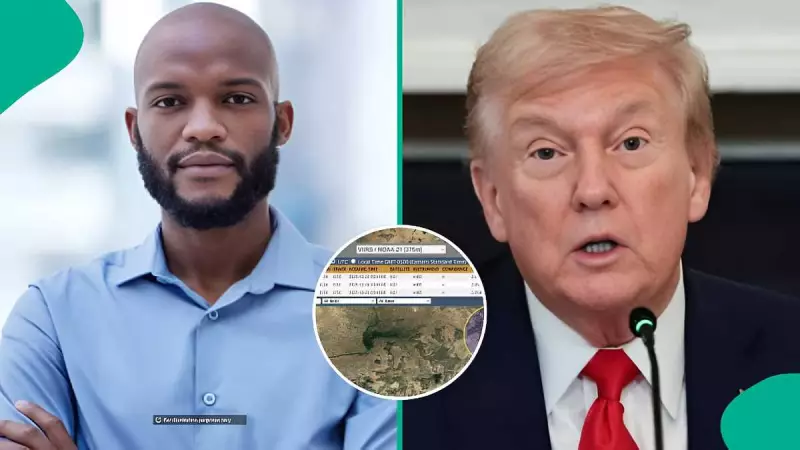
In the wake of confirmed US military strikes against ISIS targets in Nigeria's Sokoto State, a data analyst has stepped forward with what he claims is visual evidence of the operation's impact. Using publicly available satellite data, the individual has pinpointed a specific location he believes shows the aftermath of the American bombardment.
Satellite Data Points to Strike Location in Bauni Forest
The analysis was shared on social media by a user identified as @ChrisADayton, just days after former US President Donald Trump confirmed he ordered the strikes against ISIS terrorist bases in the region. In his online post, the analyst stated he had located one of the impact sites.
"I believe I have located one of the impacts of the US strikes in Nigeria," he wrote. "Recent satellite imagery shows thermal scarring and a crater in the Bauni Forest area. Further, VIIRS data records thermal detections at the time of the strikes." VIIRS refers to the Visible Infrared Imaging Radiometer Suite, a sensor on satellites used to detect heat sources like fires or explosions.
Online Reactions Praise Analytical Work
The post, which included the alleged satellite images, quickly garnered attention and praise from other social media users. Many commended the analyst for applying open-source intelligence (OSINT) techniques to the event, a method commonly used in conflict zones worldwide.
User @itz_smils commented, "Someone did the satellite part of the analysis... Heat maps are actually the standard for analysing missiles strikes all over the world, this is what is used in Sudan, Russia, Israel, Iran and any other modern conflict.... Fires don't make themselves in a flash."
Other reactions included:
- @chigozieap: "Followed you for this. Great job man."
- @Emmato13: "Great work."
- @Statecraft_NGR: "Interesting work."
The discussion also veered into strategic speculation. User @caleb_weiss7 referenced a theory that the strike's location in Sokoto, targeting the Islamic State's Sahel province (IS Sahel), could be linked to the kidnapping of an American citizen in Niamey, Niger, in October, suggesting it was a form of retaliation.
Context: Trump's Confirmation and Nigerian Discourse
This independent analysis adds a new dimension to the ongoing conversation in Nigeria about the foreign military intervention. The original confirmation from Donald Trump on December 29, 2025, stated the strikes were successful and that more could follow to dismantle the terrorist group's activities.
The event has sparked diverse reactions within Nigeria, ranging from gratitude towards the US operation to calls for more robust action by the Nigerian government. In a related report, a young Nigerian man was noted to have thanked President Trump for authorizing the bombing of the terrorists' camp after seeing a video detailing their activities.
Meanwhile, the airstrikes have also stirred religious and political commentary. Reports indicate a pastor has called for government action against prominent Islamic scholar Sheikh Ahmad Gumi over statements he made following the attack on the ISIS bases.
The work of data analysts like @ChrisADayton highlights the growing role of public, open-source investigation in understanding military and security events, providing a layer of independent verification and fueling informed public debate.