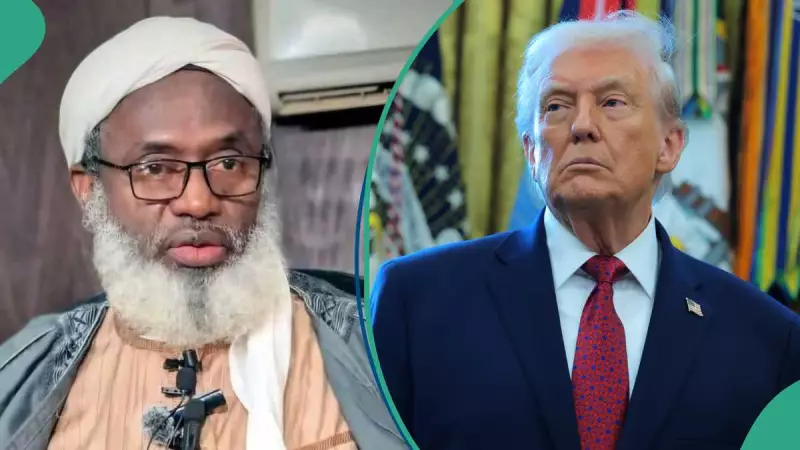
Prominent Islamic scholar Sheikh Ahmad Gumi has strongly criticized recent United States-led airstrikes in northwestern Nigeria, advocating for a shift in strategy from military bombardment to social investment in pastoral communities. His comments come amid a heated national debate following the Christmas Day operation.
Gumi's Call for Development Over Destruction
Sheikh Gumi, in a detailed Facebook post, questioned the efficacy of using heavy munitions against suspected terrorist camps. He argued that the core issue plaguing many nomadic herders is ignorance and a lack of basic amenities, not necessarily a deep-seated extremist ideology.
Reacting to a viral video showing a Fulani man with what appeared to be missile debris, Gumi highlighted the lingering danger of unexploded ordnance to civilians. He framed his critique around a stark comparison, stating, "Instead of dropping a $2m bomb that can build schools and amenities for them." The cleric emphasized his own initiative in building a school for herders, presenting it as a model for addressing the root causes of instability.
Military Confirms Gains, Civil Society Seeks Clarity
The Nigerian Army has confirmed the December 25 airstrikes, conducted in coordination with the United States Africa Command (AFRICOM), targeted Lakurawa terrorist hideouts in Sokoto State. The Acting Director of Army Public Relations, Colonel Appolonia Anele, reported that follow-up patrols confirmed extensive damage to terrorist positions in the Bauni Forest near Waria and Alkassim villages.
Colonel Anele said debris, preliminarily identified as components including fuel boosters from missiles, was recovered in parts of Sokoto and neighboring Kebbi State. The Army assured the public that all operations adhere to established rules of engagement and civilian protection protocols.
However, civil society organizations have joined Gumi in raising concerns. They have called on the Federal Government to provide transparency and a clear legal basis for allowing foreign military strikes on Nigerian soil, warning that a lack of clarity could undermine national sovereignty and heighten public tension.
Divergent Political Reactions Emerge
The airstrikes have sparked a spectrum of political reactions. Former Kaduna Central senator, Shehu Sani, publicly rejected Gumi's stance. He defended the military action as a necessary tool against armed groups, challenging critics to confront terrorists directly rather than oppose remote strikes.
Other voices adopted a more nuanced position. The Youth Party, while supporting international cooperation against terrorism, cautioned against framing Nigeria's security crisis in religious terms. The party pointed to poverty, exclusion, and weak governance as primary drivers of violence, issues it argued cannot be resolved by military means alone.
This debate occurs against a backdrop of ongoing insecurity. In a related development, Zamfara State Governor Dauda Lawal recently claimed he could end banditry in his state within two months if granted direct control of security agencies, stating he knows the precise locations of the bandits.
The discourse surrounding the U.S. airstrikes in Sokoto has thus expanded beyond immediate tactical outcomes to encompass fundamental questions about long-term security strategy, sovereignty, and the role of socio-economic development in achieving lasting peace.