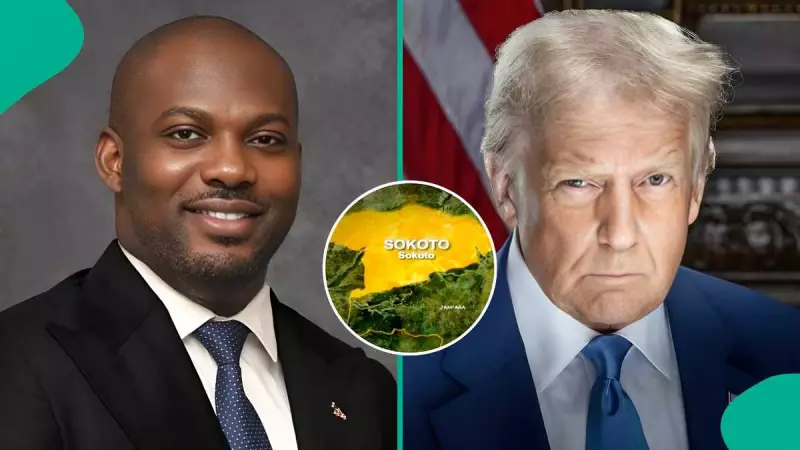
The recent United States military airstrike on suspected Islamic State (ISIS) terrorist bases in Sokoto State has ignited a firestorm of reactions across Nigerian social media. The operation, ordered by US President Donald Trump, has been dissected by commentators, with one education consultant drawing attention to a significant tactical detail many may have overlooked.
The Consultant's Observation on Modern Warfare
On December 28, exactly three days after President Trump's announcement, education consultant Alex Onyia took to social media to share his analysis. His central point focused on the method of the operation rather than just its outcome.
In his statement, Onyia stressed that the US achieved its objective without deploying a single soldier on Nigerian soil. He wrote, "Do you notice that Trump didn’t send even a soldier to Nigerian soil yet neutralized terrorists in Northwestern Nigeria? Technology is way too advanced."
He concluded his post with a plea, adding, "Let’s just let the US finish the job and save the dear lives of our soldiers." This perspective frames the event as a demonstration of how advanced technology, including drones and precision-guided munitions, is reshaping conflict and international security cooperation.
Mixed Public Reactions and Sovereignty Concerns
The post triggered a wide range of responses from Nigerians online, highlighting a deep divide in public opinion.
Some users agreed with Onyia's view, seeing it as a pragmatic solution. User @kenkenlewu commented, "This is the reality of modern security operations. Wars are no longer fought only with boots on the ground. Intelligence sharing, drones, satellite surveillance, and precision strikes do the heavy lifting now."
However, others expressed strong reservations about national sovereignty. A particularly pointed response came from user @The_Great_JiRI, who argued, "'Let US finish the job'? That mindset surrenders our sovereignty. Today it's drones we approved; tomorrow it's operations we don't control... the solution is investing in our military capacity, not outsourcing our security."
Further context was added by user @Locked_Lckd, who noted that Nigerian Foreign Minister Yusuf Tuggar had confirmed the operation was a joint effort, with President Bola Tinubu reportedly giving the green light after extended diplomatic discussions.
Background and Conflicting Narratives
The airstrike was initiated following a public announcement by President Donald Trump on December 25. He stated he had ordered the US military to execute a deadly strike on ISIS bases, confirming that several terrorists had been "neutralized."
Despite the official narrative, not all local accounts align. In a related report, a man from Sokoto contested the operation's targets, claiming the strikes hit innocent civilians in the middle of the night and called on Nigerian leaders to address this "injustice."
The event has also drawn in other figures, such as controversial Islamic scholar Sheikh Ahmad Gumi, with a pastor reportedly warning about Gumi's travel plans to Turkey in the aftermath of the bombings.
The discourse surrounding the Sokoto airstrike underscores a critical juncture for Nigeria's security strategy, balancing the immediate efficacy of foreign technological assistance with the long-term imperative of safeguarding national sovereignty and building self-sufficient defense capabilities.