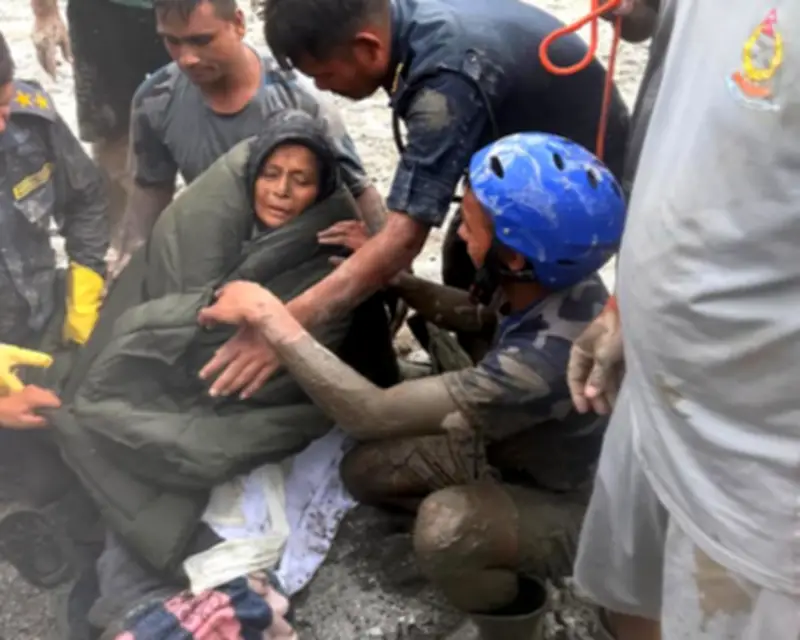
Emergency responders in Nepal have pulled a 64-year-old woman alive from her buried home in Nuwakot district, 10 days after catastrophic floods and landslides devastated the region. The woman, identified as Chandrika Shrestha, was discovered submerged in mud by members of Nepal's Armed Police Force on Saturday, September 5, and was immediately airlifted to Kathmandu for medical treatment.
Woman Found in Mud-Caked Home After 10 Days
Photos released by the Nepali army show rescuers uncovering Shrestha from the thick sludge that had engulfed her four-storey house in Betrawati, Nuwakot. Only part of the structure remained visible, with the lower floors completely buried under debris. Police deputy superintendent Iqbal Hawari confirmed the rescue to AFP, stating, "A police team found her as they were clearing the area. She has been airlifted to Kathmandu for treatment."
The rescue came as search operations entered their 11th day following the floods triggered by a glacial and rock collapse on August 26. Shrestha's family, according to social media posts, had reportedly given up hope and had begun preparing for her funeral before the miraculous discovery.

Second Tunnel Rescue Raises Hopes
In a separate operation on the same day, a Chinese national was found alive inside a 225-metre tunnel at the Upper Trishuli-1 Hydropower Project in Rasuwa district. The Nepali military said a joint team of army personnel and South Korean disaster experts carried out the rescue, with the man undergoing a health assessment after being evacuated by helicopter.
Two Nepali workers were also rescued from another tunnel in a hydro-station on the Trishuli River on Friday, September 4. Rescue efforts have focused on a dozen hydropower projects across Nepal, where approximately 900 workers remain missing, 500 of whom are believed to be trapped in massive tunnels. International rescue teams from India, China, South Korea and the US have been combing through debris and damaged structures in search of survivors.
Death Toll Climbs Past 1,375
According to Nepal's disaster management agency, at least 1,375 people have been killed in the floods, with more than 5,000 still unaccounted for. Social media reports from the ground indicate that 1,344 bodies have been recovered so far, including 758 adults and 85 children, with 501 bodies found missing body parts. The figures have not been independently verified.
The rescue work has been hampered by the extensive infrastructural damage caused by the disaster. More than 40 bridges have collapsed, and rivers continue to swell unpredictably, complicating access to affected areas. Experts have cautioned that the likelihood of finding more survivors in the tunnels is diminishing as time passes.
Emergency responders continue to search through the rubble, focusing on the hydropower projects where hundreds of workers remain trapped. The international community, including teams from India, China, South Korea and the US, is supporting Nepali authorities in the ongoing operations.