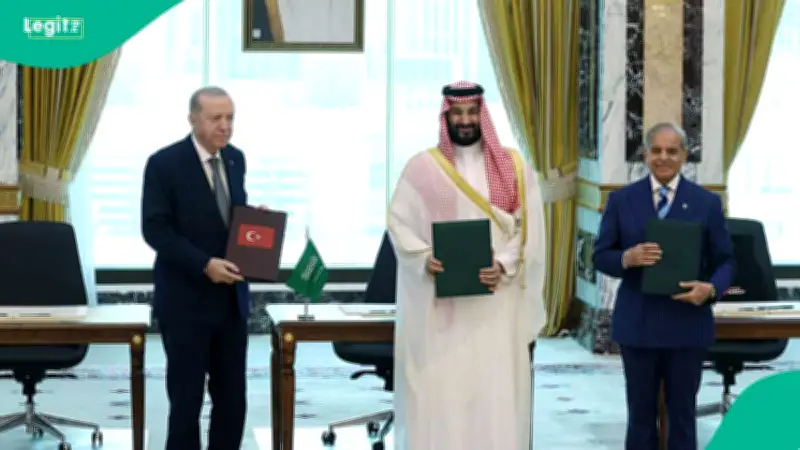
In a landmark move, Saudi Arabia, Turkey, and Pakistan formalised a trilateral defence agreement in Mecca on Friday, binding three of the Muslim world's most powerful states together as the Middle East faces its most severe security crisis in decades. The pact, signed by Crown Prince Mohammed bin Salman, Turkish President Recep Tayyip Erdogan, and Pakistani Prime Minister Shehbaz Sharif, follows nearly a year of negotiations first reported by Reuters in January.
Collective Defence Clause
The three leaders said in a joint statement that the "Mecca Joint Defence Agreement" is designed to strengthen collective deterrence, with an armed attack against any one of them to be treated as an attack on all three. However, the statement did not spell out the specific military commitments each country has taken on, leaving open how far the agreement would compel any of them to take direct military action in defence of the others.
Turkish Vice President Cevdet Yilmaz said the agreement was not directed at any particular country, while a Turkish official added that it was purely defensive in nature and did not override existing agreements any of the three countries hold with other states. Saudi Deputy Minister for Public Diplomacy Rayed Krimly was equally measured in his assessment, writing on social media that the accord "does not represent an effort to establish a military axis or a sectarian bloc. Nor is it linked to any nuclear ambitions or arms race."
Military and Strategic Weight
The three nations bring considerable combined weight to the arrangement. Turkey operates NATO's second-largest military. Saudi Arabia is home to Islam's holiest sites and ranks among the world's leading oil exporters. Pakistan is the only Muslim-majority country with nuclear weapons, though Islamabad has consistently played down suggestions that its nuclear deterrent could be extended to allies, saying last year of its bilateral pact with Riyadh that atomic weapons were "not on the radar."
Pakistan already has roughly 8,000 troops, fighter jets, drones, and an air-defence system deployed inside Saudi Arabia, while Turkey and Pakistan have exchanged warships and training aircraft over the years, and Saudi Arabia regularly purchases Turkish-made drones.
Regional Context and Analyst Reaction
The pact emerges against the backdrop of escalating conflict across the Middle East, which has been in turmoil since the Hamas attack on Israel on October 7, 2023. Israel has since waged war in Gaza, invaded southern Lebanon, seized territory in Syria, and launched two air campaigns against Iran. In turn, Tehran has fired on Saudi Arabia, Kuwait, Bahrain, Qatar, the United Arab Emirates, Oman, Jordan, and Israel since the United States and Israel struck Iran on February 28.
Abdulaziz Sager, chairman of the Gulf Research Center, said the gathering carried significant weight. "Three of the Muslim world's most influential states are convening at a moment of heightened uncertainty, demonstrating a growing willingness among regional and middle powers to coordinate more closely on security matters," he said, adding that the trilateral framework could help build "a more regionally driven security architecture."
Burcu Ozcelik, senior research fellow for Middle East Security at the RUSI think tank, said the pact was focused on counterbalancing Iranian influence and building deterrence against Israel rather than seeking direct confrontation with Tehran. "I think the objective is very much the opposite," Ozcelik said.
International Reactions and Broader Implications
Israeli Prime Minister Benjamin Netanyahu's office declined to comment. India's Foreign Ministry said the development was one it was closely watching. Iran had not commented by the time the agreement was announced.
The pact comes amid heightened global alerts. The United States State Department on Sunday, July 19, re-issued its Worldwide Caution advisory, warning American citizens in all parts of the world to exercise heightened vigilance as concerns grow that Iran or groups aligned with it could strike US interests far outside the Middle East. The alert, first put in place in February, was reiterated amid a sharp deterioration in regional security. The State Department stressed that the security environment remains "complex" and warned that the conflict could escalate with little or no warning.