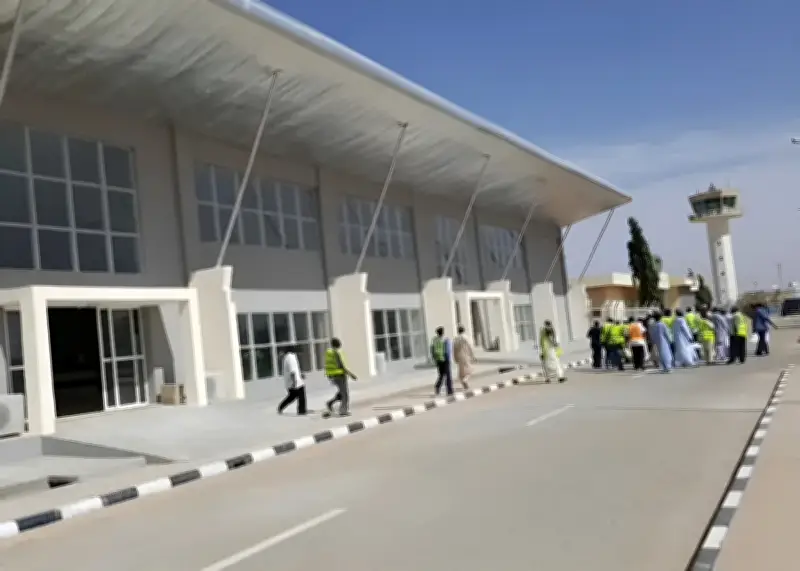
Seven suspected commanders of Boko Haram and ISWAP were arrested at the Umaru Musa Yar’Adua International Airport in Katsina upon their return from the 2026 Hajj pilgrimage in Saudi Arabia, the Minister of Interior, Olubunmi Tunji-Ojo, announced days later. The arrests, carried out discreetly by border control officers during routine immigration clearance, have sparked intense national debate about how the suspects managed to leave Nigeria in the first place.
Arrest Operation at Katsina Airport
The atmosphere inside the international arrivals terminal was one of celebration as families waited to embrace relatives returning from Saudi Arabia. Airport officials moved through routine administrative procedures as returning pilgrims wheeled their luggage toward the main arrival hall after presenting travel documents for border clearance. Without warning, immigration officers quietly isolated seven men from the rest of the arriving passengers. There was no public commotion. The men were discreetly separated, escorted out of public view under heavy security, and placed in immediate custody. Within hours, they were moved under armed escort to Abuja and handed over to the State Security Service (SSS).
Minister Tunji-Ojo stated that security agencies had intercepted seven suspected commanders of Boko Haram and ISWAP who had returned from the Hajj through the Katsina airport. The government presented the arrests as evidence of Nigeria’s expanding digital border management capabilities, highlighting advancements in biometric identity verification and real-time intelligence coordination among security agencies.
Key Questions Remain Unanswered
As of the time of publishing, neither the federal government nor the SSS has publicly released the identities of the seven suspects or announced any criminal charges against them. The most critical question raised by the operation is how the men managed to leave Nigeria. Immigration officials familiar with the operation confirmed to PREMIUM TIMES that the seven suspects travelled using valid Nigerian international passports issued in their own legal names and identities. They completed all official Hajj travel procedures before departing.
This paradox raises difficult accountability questions: What specific security screening protocols exist before an intending pilgrim is cleared to leave Nigeria? Which institutions bear the statutory responsibility for identifying registration applicants on national security watchlists? Did the intelligence identifying these suspects emerge only while they were overseas, or were crucial opportunities to intercept them missed before they boarded their outbound flight?
How the Hajj Vetting System Works
Travelling for Hajj is a highly regulated bureaucratic process involving state governments, federal agencies, and Saudi Arabian authorities. The operational chain begins at the grassroots level under state agencies like the Katsina State Pilgrims Welfare Board, where designated officials receive applications and guide prospective pilgrims through registration. The National Hajj Commission of Nigeria (NAHCON) sets the official annual Hajj fare, which has risen sharply to between seven and eight million Naira due to inflation and exchange rate fluctuations. Prospective pilgrims deposit the fare into state board bank accounts.
Once financial obligations are satisfied, the applicant proceeds to documentation. The international passport has become the centralised identity document, embedding biometric data and National Identification Numbers (NIN) following enrollment by the Nigeria Immigration Service (NIS). The state pilgrims welfare board compiles a comprehensive register of qualified applicants, which is transmitted to NAHCON for national coordination. NAHCON uploads the data into Saudi Arabia’s electronic Hajj portal, where the Saudi Ministry issues mandatory entry visas electronically. Only after visa approval are pilgrims assigned to outbound flights.
Division of Responsibilities
According to immigration officials who spoke anonymously, the NIS’s primary mandate at departure terminals is to enforce immigration laws, establish identity, and verify the physical integrity of travel documents. An immigration officer explained that routine immigration clearance remains an identity check, whereas the specialised tracking of terrorism suspects falls within the purview of intelligence agencies. NAHCON spokesperson Fatima Usara clarified that NAHCON does not conduct background checks or profile individual travellers. She stated that state pilgrims’ welfare boards function as direct operators, handling grouping and overseeing pilgrim manifests, while NAHCON acts strictly as a manager and regulator.
This dynamic exposes a critical operational divide. While border immigration personnel verify identity at the point of travel and federal regulators monitor compliance, the active vetting of individual backgrounds rests with state-level frameworks. Many states lack the capacity for such vetting, as Nigeria operates a unitary security system where virtually all security agencies are federally controlled.
Why Suspects Were Not Intercepted at Departure
According to an immigration officer privy to the airport operation, the suspects were not intercepted at departure because the active intelligence process had not reached the stage where a physical border interception could be authorised. The source stated that the investigation was still active during the outbound journey, but before the return flight landed, the intelligence process had matured, and a definitive directive was transmitted from Abuja to apprehend specific passengers upon arrival. A senior NIS official revealed that the suspects’ data profiles had been processed and watchlisted by the NIS Integrated Operations Centre before their return, and the border management platform was fully prepared for their arrival.
All officials confirmed that the seven suspects travelled using valid passports issued under their real names. However, allowing terror suspects to travel for Hajj only to arrest them upon return carries risks, including potential arrest by Saudi authorities or acts of terror in Saudi Arabia, which would damage Nigeria’s reputation. The SSS declined to comment on this report.
Local Accountability and Allegations
The institutional silence surrounding pre-departure vetting has fueled public debate in Katsina State. Bashir Kurfi, a local social critic, raised questions about whether the suspects had been beneficiaries of official state-funded Hajj as part of local political amnesty and disarmament packages. The Katsina State Ministry of Internal Security and Home Affairs described the allegations as entirely baseless and politically motivated. Commissioner Nasir Mu’azu warned that the state government would pursue legal remedies against persons spreading defamatory misinformation. PREMIUM TIMES found no evidence that the detainees were beneficiaries of state-sponsored Hajj.
Abdulrahman Abdullahi, chairman of the Coalition of Civil Society Organisations in Katsina State, emphasised that the prolonged nature of Hajj logistics makes the lack of pre-departure detection a major public concern. “An international pilgrimage is not an impromptu journey where a traveller walks into a commercial motor park and boards a vehicle,” he told PREMIUM TIMES. “If individuals later officially labelled as security suspects completed all those stages before travelling, then it is important to understand what happened during that period. Security arrangements need to be proactive, not reactive.”
Jamilu Charanchi, national coordinator of the Coalition of Northern Groups, argued that the incident exposes the need for an independent review of the screening architecture. “If individuals suspected of serious involvement in terrorism can seamlessly utilise our official state pilgrimage pipelines to exit and re-enter the country unhindered, the current screening system demands deep scrutiny,” he told PREMIUM TIMES. “Both the federal government, the state authorities, and the security leadership must constitute an independent investigative committee involving security agencies and relevant Hajj authorities to identify possible gaps in the screening process and strengthen future pilgrim vetting.”
Previous Security Arrests Linked to Pilgrimage
This is not the first time Nigerian security agencies have arrested high-profile suspects in connection with religious pilgrimage. In May 2025, SSS operatives arrested two wanted kidnap suspects during pre-departure Hajj screening: Yahaya Yakubu at the Abuja Hajj camp and Sani Galadi at the Sokoto Hajj camp. In September 2022, Tukur Mamu, who later faced terrorism-related charges, was intercepted in Cairo while travelling for Umrah. The Katsina case differs because the suspects were intercepted after completing the Hajj and returning to Nigeria, and their arrest was publicly presented as an example of the efficiency of Nigeria’s integrated biometric border management system.
Transparency Inquiries and Outstanding Responses
PREMIUM TIMES sought clarification from all primary organisations. The SSS did not respond to questions about whether the suspects were under investigation before leaving Nigeria or when they were watchlisted. NAHCON clarified its administrative role. The NIS Public Relations Officer, Akinsola Akinlabi, confirmed that the Service arrested the suspects and handed them over to the requesting agency but declined to comment on operational details. The Katsina State Pilgrims Welfare Board declined to discuss screening procedures, stating it is an administrative entity, not a security agency. The Katsina State Government denied any state sponsorship of the suspects’ travel.
As the seven suspects remain in federal custody and investigations continue, the central questions remain unresolved. The arrests demonstrated that Nigeria’s border security system can identify watchlisted travellers at the point of arrival. What remains unclear is whether the institutions responsible for processing intending pilgrims had access to information that could have prevented the journey. Until those questions are answered, the case will continue to test Nigeria’s counterterrorism architecture and the accountability of agencies responsible for the country’s largest annual international migration.