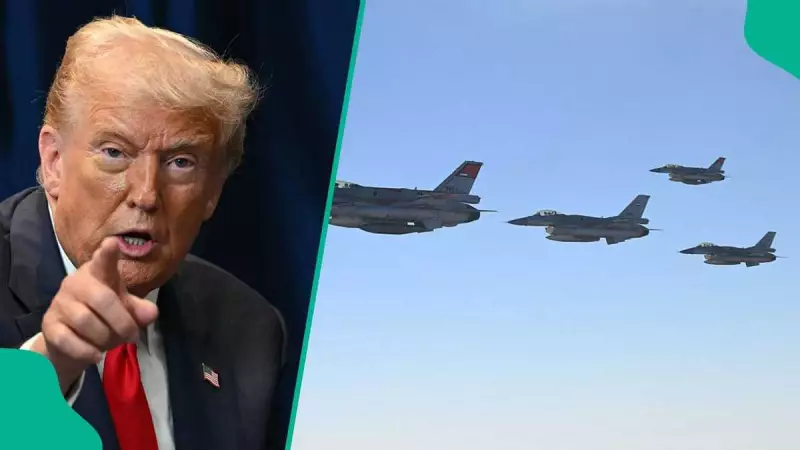
The precision airstrikes carried out by the United States against ISIS-linked militants in Sokoto State on Christmas Day have brought into sharp focus the complex relationship between military action and civilian perception in counterterrorism efforts. While the operation demonstrated advanced technical capability through international partnership, a peace and conflict analyst argues that the strategic success of such actions hinges on more than just neutralizing targets.
The Psychological Impact of Precision Strikes
For communities in Northwest Nigeria, the sudden arrival of international aerial firepower during a period of communal gathering like Christmas represents a profound psychological event. Peace and conflict analyst Lekan Olayiwola explains that such interventions force a recalibration of how the state is perceived locally. When the government appears primarily through episodic, unexplained force rather than consistent governance, it risks being seen as distant and impersonal.
The timing of operations carries heavy symbolic weight. Conducting high-intensity strikes on days of communal rest, such as Christmas, market days, or religious observances, creates a cognitive shock for civilians. In areas like Sokoto, burdened by years of displacement and insecurity, these events are woven into collective memory, potentially deepening a sense of communal fatalism.
The Critical Narrative Vacuum After an Attack
A major challenge identified in the aftermath of the Sokoto strikes is the information vacuum. While operational secrecy is a hallmark of effective counterterrorism, the period immediately following an action is a critical window for narrative control. When the state fails to provide a clear, proactive explanation, the space is rapidly filled by insurgent groups, local power brokers, religious figures, and rumor networks.
This contest over meaning is what Olayiwola describes as a struggle for narrative sovereignty—the state's ability to define events within its territory. Without it, even successful kinetic actions can be reinterpreted by affected communities. In Sokoto, there is a risk that precision strikes are being cognitively reclassified not as protective actions by the Nigerian state, but as foreign interventions conducted over the heads of the local population, leading to a state of "protective alienation."
Legitimacy as a Practical Counterinsurgency Asset
The analyst stresses that legitimacy is not an abstract concept but a practical military asset. It determines whether civilians will warn soldiers of ambushes, report suspicious movements, or tolerate short-term disruption for promised long-term security. In counterinsurgency, civilian neutrality often benefits militant resilience.
History from contexts like Afghanistan, Mali, Colombia, and Northern Ireland shows that campaigns focused on attrition while neglecting civilian cognition achieve disruption, not stability. Victory is secured when the population views the state as the most legitimate provider of order. Every military operation, therefore, silently answers a crucial question for civilians: who is this violence for?
To prevent this erosion of trust, an integrated approach is necessary. Precision from the air must be matched by a visible presence on the ground. This presence need not be militarized; it can involve local officials, traditional authorities, or humanitarian coordination. The goal is to restore relational contact and anchor the event in a framework of national protection, ensuring strikes are seen as steps toward a shared peace, not merely as "fire from above."