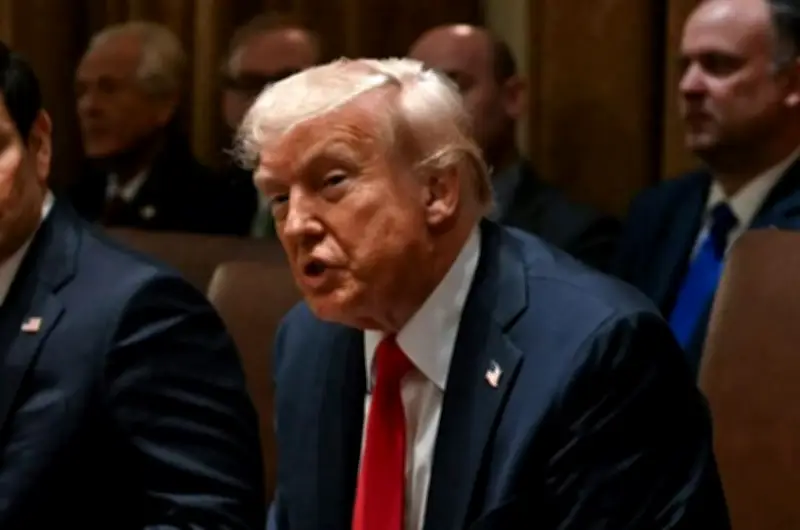
President Donald Trump has announced his intention to declare the Strait of Hormuz a US territory once Iran is defeated, a move that has drawn immediate opposition from Tehran. Speaking to a rally crowd in Nassau County on Friday, Trump said, “After we finish defeating Iran, which is being very badly defeated, I’ll be declaring the Hormuz Strait a territory of the United States.”
Trump's Statement and Justification
Trump told the crowd that the defeat of Iran would happen “pretty soon,” and acknowledged that making the international waterway a US territory would require deploying troops in the area indefinitely. “Essentially, that’s what it is. We have the blockade. No ships get through unless we want them to,” he added.
The President also addressed the impact of the conflict on American consumers, saying he has no regrets about the war. “I will never apologise for taking military action against Iran,” he stated, arguing that higher gas prices are justified in preventing Iran from acquiring a nuclear weapon. He told the crowd, “For you to pay a tiny little bit more for your gasoline, just remember you’re doing it so that a very evil country cannot have — a country, really, it’s the number one state sponsor of terror in the world — we don’t want to have them have a nuclear weapon. So remember that when you have to pay a little bit more.”
Iran's Firm Rejection
Iran has categorically rejected the possibility of the Strait being seized or becoming a US territory. Deputy Foreign Minister Kazem Gharibabadi issued a statement saying, “The Strait cannot be seized with a tweet, an aircraft carrier, an executive order, or a campaign speech. Iran neither fears threats nor is intimidated by displays of force.” He further asserted, “The strait will be closed or opened solely under Iran’s authority, and as long as you refuse to accept the reality of defeat and abandon your delusions, Iran will continue enforcing the blockade.”
Iran has consistently denied seeking a nuclear weapon, while successive US and Western leaders have insisted it has a plan for one. The dispute over the Strait has been central to peace negotiations between the two countries, which have been locked in a struggle over control of the narrow maritime route for months.
Impact on Global Energy and Negotiations
Before the US-Israeli joint attack in February that triggered the war, navigation through the Strait was free for everyone. An Iranian blockade, followed by a US blockade, disrupted the energy market and caused oil prices to skyrocket globally. The strategic waterway is a critical chokepoint for oil shipments, and any prolonged disruption has significant economic consequences worldwide.
Negotiation attempts have been fraught. On Sunday, Trump said the US was “low-keying” considering talks with Iran, stating in an interview with Axios, “We are only semi-negotiating with them.” However, Iranian Foreign Minister Abbas Araghchi said in the early hours of Saturday that Tehran has not decided whether to resume negotiations with the US. Araghchi noted that mediators Qatar and Pakistan have exchanged messages, but those interactions do not constitute negotiations.
As tensions remain high, the future of the Strait of Hormuz and the broader US-Iran conflict continues to hinge on diplomatic efforts and military posturing, with no immediate resolution in sight.