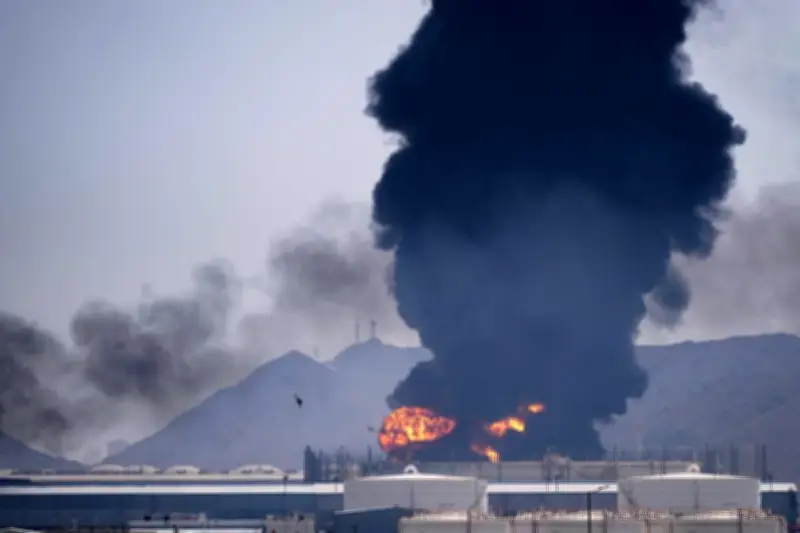
US Military Strike on Larak Island
The United States has carried out a military strike on Iran's Larak Island in the Strait of Hormuz, further escalating tensions after President Donald Trump declared the US was 'not finished' with the ongoing conflict. The strike comes as fighting around the strategic waterway derailed a preliminary agreement between Washington and Tehran.
US Remains Open to Negotiations
Despite the setback, US Secretary of State Marco Rubio said the United States remains open to negotiations. 'We remain open to working it out in a negotiated way. But right now, they don't seem to be serious about that,' Rubio said. Rubio defended the military action, accusing Iran of targeting commercial shipping in the Strait of Hormuz and attempting to rebuild its missile and drone capabilities.
Iranian Response
Iranian Foreign Ministry spokesman Esmaeil Baqaei said diplomatic contacts between both countries were still ongoing through mediators. According to Iran's Tasnim news agency, a US missile struck Larak Island on Wednesday, with authorities assessing the extent of the damage. The US military has repeatedly targeted Iranian islands in the Gulf and Strait of Hormuz since hostilities resumed.
Cost of the Conflict
The conflict has become increasingly costly for Washington, with the Pentagon estimating the war has cost the US $37.5 billion. Despite growing domestic pressure to end the conflict ahead of November's legislative elections, Trump insisted the military campaign would continue. 'We're not finished at all… we're not leaving right now,' Trump said.
Continued Strikes and Threats
The US military also confirmed it had launched an eleventh consecutive night of strikes, saying the attacks were aimed at reducing Iran's ability to threaten commercial shipping in the Strait of Hormuz. Trump also warned that a future target could be the underground Pickaxe Mountain complex near Natanz, where Western intelligence agencies suspect Iran may be developing an undeclared uranium enrichment facility.
Iran's Warning on Escalation
Iran warned that any attack on the site would mark a major escalation. The Khatam Al-Anbiya military command said it would view such an attack as 'an expansion of war in the region' and threatened to strike 'all the interests of America, the allies and supporters.' Baqaei dismissed the allegations surrounding the site, insisting there was no nuclear activity there and accusing Washington of using it as a pretext for further military action.
IAEA Involvement
Baqaei also criticised the International Atomic Energy Agency (IAEA), questioning the absence of its Director General, Rafael Grossi, while accusing the US of violating UN rules. Grossi earlier told the BBC that IAEA inspectors should return to Iran soon to verify the country's stockpile of highly enriched uranium.
Regional Spread
The conflict also spread across the Gulf region. Kuwait said its air defence systems intercepted Iranian drones, while Jordan announced it had shot down four missiles and four drones. Air raid sirens were also activated in Bahrain after explosions were heard in the capital, Manama. Iran's military claimed responsibility for attacks targeting US military assets in Kuwait and Bahrain, including air defence systems, radar installations and administrative facilities. The Islamic Revolutionary Guard Corps (IRGC) also claimed to have targeted US bases in Jordan.
Houthi Threat and Oil Prices
Meanwhile, Yemen's Houthi rebels threatened to blockade Saudi Arabian ports, prompting Trump to warn that the US would 'take care of' the group if it carried out the threat. Although no new attacks on shipping have been reported, maritime intelligence firm Vanguard Tech said two oil tankers reversed course in the Red Sea after loading crude from Saudi Arabia's Yanbu port. The threat pushed global oil prices higher, with Brent crude rising 4.4 percent to more than $95 per barrel, its highest level in six weeks. Analysts warn that any disruption to Saudi export routes could have significant consequences for global energy markets.