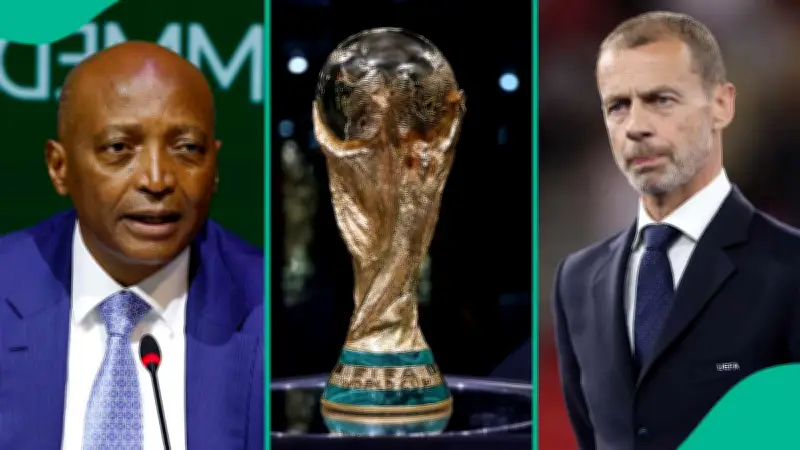
African nations competing at the 2026 FIFA World Cup have united with other countries to condemn comments made by UEFA president Aleksander Čeferin regarding the expanded tournament. The joint statement, issued by all 10 African representatives along with Curaçao, Uzbekistan, and Haiti, expressed profound disappointment over remarks that questioned the value of matches involving newly qualified nations.
African Teams Reject UEFA Chief's Remarks
The African teams—Ghana, Morocco, Egypt, Senegal, South Africa, Algeria, Tunisia, DR Congo, Côte d'Ivoire, and Cape Verde—joined forces after Čeferin suggested that the enlarged 48-team World Cup would produce several uninteresting fixtures. Speaking to Slovenian outlet Delo, the UEFA president said: "In my opinion, this is not a good decision, because we have a lot of matches that are completely uninteresting. Europe had 13 teams at the World Cup in Qatar, and now it has 16. This is a small difference, while some national teams came to the World Cup that would not have won a single match in Europe."
The joint statement firmly rejected these comments, stating: "We respectfully but firmly reject these comments. For our countries, there is no such thing as an unimportant World Cup match." The statement highlighted the historic significance of qualification for smaller nations, noting that for Cape Verde, Curaçao, and Uzbekistan, qualification represented a historic achievement and the realization of a dream shared by generations. For nations such as Congo and Haiti, returning to football's biggest stage after a long absence carried special meaning for millions of supporters who had waited years or decades for this moment.
Football Does Not Belong to a Select Group
The countries argued that the comments failed to recognize the sacrifices made by players, coaches, and supporters across the globe. "To suggest that these matches are somehow less important is deeply disappointing and fails to recognize the efforts, sacrifices and aspirations of players, coaches, clubs, football leaders and supporters across the world," the statement read. "Behind every qualification stand years of work and investment. Behind every national team stand entire communities and millions of people who see football as a source of pride, hope and unity."
The statement emphasized that football's strength comes from its diversity and universality. "Football does not belong to a select group of nations. Its strength comes from its universality. The FIFA World Cup is the world's greatest football competition precisely because it brings together different cultures, different histories and different football journeys."
The countries added: "For many countries, participation in the FIFA World Cup is not only a sporting achievement. It is a moment that inspires a generation, accelerates football development and creates memories that last a lifetime. We believe that every nation that qualifies deserves respect. Every team has earned its place on merit. Every supporter has the right to dream. Every match carries meaning for millions of people around the world."
Expanded Tournament Remains Controversial
FIFA increased the World Cup from 32 to 48 teams for the 2026 edition, giving Africa nine automatic slots and one intercontinental playoff place. The new structure has continued to divide opinion in Europe, with UEFA receiving 16 places. Čeferin argued that Europe had been short-changed despite winning four of the last five World Cups. His remarks came months after former Italy coach Gennaro Gattuso generated controversy over Africa's increased representation.
Following Italy's victory over Moldova in November 2025, Gattuso complained that Europe had become the confederation most affected by the changes. "In my day, the best runners-up went straight to the World Cup," Gattuso said. "In 1990 and 1994 there were two (African) teams – now there are nine. It’s not a controversy, but it creates difficulties."
The joint statement concluded by reaffirming the belief that the growth of football must continue to create opportunities and inspire new generations. "Every team qualified on merit. Every match matters," the statement said.