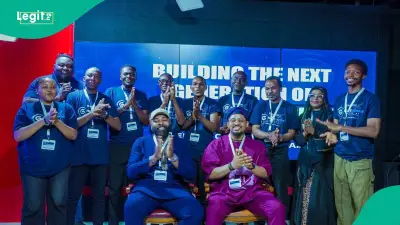
As Nigeria gears up for its 2027 general elections, a stark warning has emerged from global scholars: artificial intelligence (AI) could either strengthen democratic discourse or deepen societal divides. In a compelling analysis, Dr. Margee Ensign and Dr. Jacob Udo-Udo Jacob, leaders of the Global Centre for Rehumanising Democracy (GCRD), argue that the upcoming electoral cycle will be fought not just at polling stations but in the digital arena, where AI-generated content is becoming increasingly prevalent.
The AI Dilemma in Nigerian Politics
The presidential and National Assembly campaigns officially begin on 19 August, with Nigerians voting on 16 January 2027, followed by governorship and State Assembly elections on 6 February. However, the real battleground will be on platforms like X, Facebook, TikTok, Instagram, YouTube, and WhatsApp, where viral videos, memes, and anonymous accounts—often powered by AI—will shape public perception.
"The same technology that can expand human capability can also deepen inequality, industrialise misinformation, and amplify political division," the authors write. They stress that the defining question is not whether AI will be used, but what kind of societies it will help build.
Measuring Democracy's Vital Signs
To address this, GCRD has developed the Democracy Discourse Index (DDI), a tool that combines human research and AI to assess the democratic quality of public discourse. The DDI analyses large volumes of publicly available discourse against indicators organized around four themes: empathy, civility, trust language, and democratic agency.
"Dangerous political environments rarely emerge overnight," the experts note. "Before communities become enemies, people learn to describe one another as enemies; before citizens abandon democratic institutions, distrust and hopelessness become normalised." The DDI aims to detect these shifts early, giving societies a chance to respond.
AI Education for Nigerian Youth
A key focus of the DDI is preparing young people to live responsibly in an AI-saturated world. The authors argue that education must go beyond digital literacy. "Teaching students merely how to prompt ChatGPT will not be enough," they warn. "They need critical thinking to understand bias, misinformation, and algorithmic amplification, and an ethical framework for deciding what technology ought to be used for."
For the past year, GCRD has been conducting an experiment with university students and faculty in Pakistan, Albania, Greece, Bulgaria, North Macedonia, and the United States. Students examine real public conversations and learn to identify characteristics of political communication. Their human annotations are then used to train AI systems for larger-scale analysis.
Nigeria's Unique Opportunity
The implications for Nigeria's 2027 elections are substantial. The DDI could help detect dehumanising rhetoric against ethnic or religious communities before it leads to offline violence. It could also help journalists distinguish isolated offensive posts from coordinated hostility, and identify communities where Nigerians respond to disagreement with empathy and solidarity.
"Fact-checking remains essential, but identifying whether a claim is true or false addresses only part of the problem," the authors argue. "A technically accurate statement can still be used to dehumanise." They emphasise the need to understand the condition of the conversation itself.
Nigeria, with its extraordinary linguistic, religious, ethnic, and cultural diversity, is described as "one of the world's most important laboratories for understanding how human beings negotiate difference." The authors call on Nigeria to be at the centre of building AI that strengthens human dignity and democratic agency.
Global Virtual Forum
On Monday, students and faculty participating in the DDI consortium will meet in a global virtual forum to present their findings. The event is free and open to participants interested in exploring how universities can use AI to strengthen democratic citizenship.
As Nigeria enters its first general election of the generative-AI age, the authors urge the nation to "build the intellectual, technological, ethical, and civic capacity to recognise and strengthen what can hold our societies together."