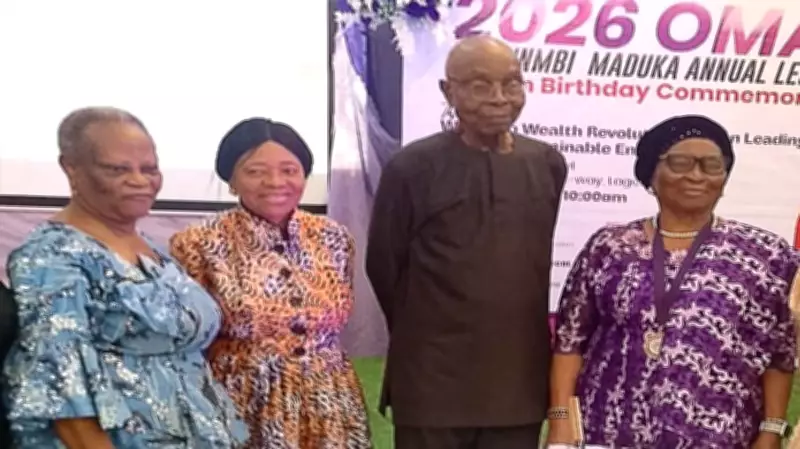
The Association of Professional Women Engineers of Nigeria (APWEN) has urged women engineers to support the country's waste-to-wealth revolution by designing equipment that can address waste management challenges nationwide.
Founder and Chief Executive Officer of MitiMeth, Achenyo Idachaba-Obaro, made the call during the seventh edition of the Olutunmbi Maduka Annual Lecture (OMAL) and the 85th birthday celebration of Joanna Maduka in Lagos. She urged women engineers to take the lead in manufacturing machinery innovations, biomaterial processing for paper and textiles, manufacturing optimisation, renewable energy integration, and scalable production systems such as tech-enabled looms.
The event attracted industry leaders, professionals and other stakeholders who explored innovative pathways to sustainability and women-led enterprise growth in Africa. The lecture series was established to celebrate Maduka's contributions to advancing women in engineering, science and technology, as well as promoting women's role in national development.
Speaking on the theme, Waste to Wealth Revolution: Women Leading Africa's Sustainable Enterprises, Idachaba-Obaro said women-led enterprises across Africa are transforming waste streams into community-centred businesses that combine circular design, craftsmanship, livelihood creation and environmental stewardship. She noted that craft-based systems face challenges without technological upgrades, including low production capacity, inconsistent quality, labour pipeline issues and weak global competitiveness.
Idachaba-Obaro, whose work focuses on producing handmade interior décor and lifestyle accessories from water hyacinth, banana fibre, coconut shells and bamboo, said women driving the waste-to-opportunity revolution are not merely recycling waste but redesigning value chains and rebuilding local economies. According to her, Africa's next-generation circular enterprises will combine artificial intelligence, craftsmanship, engineering, material science and digital systems, adding that such enterprises are more likely to remain sustainable in the long term. She also called for mentorship programmes for students with innovative ideas aimed at solving community problems.
President of APWEN, Chinyere Igwegbe, said Maduka did not just establish APWEN but created a movement that has significantly developed professional women engineers, with membership now exceeding 8,000 and thousands of student members. She stated that at a time when female engineers were counted on one hand, Maduka dared to say, We must encourage, enhance and excel. She and the founding members gave women a platform where competence meets courage and where sisterhood fuels success. Today, APWEN stands tall across Nigeria and beyond, not as a footnote in engineering, but as a formidable force.
Speaking on the waste-to-wealth drive, Igwegbe said Africa generates millions of tonnes of waste annually from agricultural residue, plastics, e-waste and organic refuse, but women engineers are increasingly transforming these challenges into economic opportunities. Across the continent, women are turning discarded bottles into building materials, cassava peels into bioplastics and landfill gas into electricity. She added that Idachaba-Obaro had demonstrated what is possible by converting water hyacinth from an invasive weed into products that support commerce, craft and climate action. This revolution is not about cleaning up after others; it is about women taking the lead in circular economies, green manufacturing and sustainable enterprise.
Igwegbe disclosed that APWEN remains committed to equipping its members with the technical and entrepreneurial skills needed to convert waste streams into wealth streams. President of the Nigerian Society of Engineers, Alli Rabiu, represented by Deputy President Valerie Agberagba, commended APWEN for sustaining the initiative over the past seven years. According to him, OMAL has evolved into a strategic platform for shaping ideas, nurturing talents and influencing policy directions critical to Nigeria's development. Rabiu stated that the theme rightly places women engineers at the forefront of this transformation, driving innovation, promoting sustainability and catalysing enterprise development across the continent. The Nigerian Society of Engineers strongly aligns with this vision, believing that sustainable engineering solutions, powered by inclusive participation, are central to achieving economic resilience and environmental stewardship.
Addressing participants, the celebrant Joanna Maduka appreciated friends, family members and professional colleagues for honouring her despite the unfavourable weather conditions. She also reiterated the need for stronger mentorship, the training of more engineers and collective efforts to tackle societal challenges confronting Nigeria.