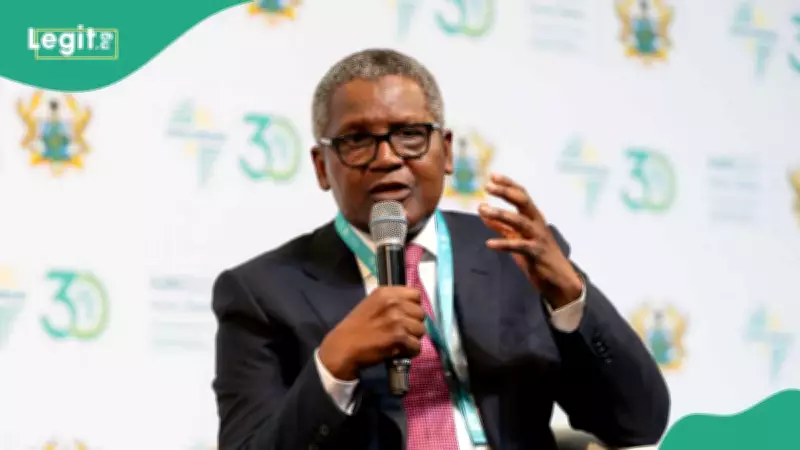
Africa's richest man, Aliko Dangote, has announced plans for a massive 20,000-megawatt power project, marking one of the most ambitious private-sector energy investments in Nigeria's history. The billionaire businessman revealed the plan during an interview with Makhtar Diop, Managing Director of the International Finance Corporation (IFC), signaling a major expansion of his business empire beyond cement, oil refining, fertiliser, and petrochemicals.
Dangote to Generate More Than Nigeria's Electricity Consumption
His latest move places him on a potential collision course with fellow billionaire Femi Otedola, whose Geregu Power Plc remains one of Nigeria's leading power generation companies. Dangote stated, "We are now going into power, 20,000 megawatts," emphasizing that energy remains one of Africa's most urgent development needs.
Bigger Than Nigeria's Current Available Power Supply
According to multiple reports, including Punch and BusinessDay, Dangote's proposed 20,000MW project is significant because it exceeds much of Nigeria's currently available electricity generation. Although Nigeria has an installed generation capacity of about 13,000MW, actual power supplied to homes and businesses remains far lower due to transmission bottlenecks, gas shortages, and ageing infrastructure. If successfully executed, the project could dramatically reshape Nigeria's electricity landscape, improve industrial productivity, and reduce heavy dependence on self-generated power through diesel and petrol generators. However, Dangote did not disclose the financing structure, project timeline, or whether the power initiative would be tied to industrial operations or the national grid.
Expansion Fueled by Strong Cash Flow
Dangote explained that the move into power is backed by stronger financial flexibility and improved cash flows across his businesses. "We are now actually free of assets, and we can actually raise more money. Our cash flow now is very, very strong," he said. He also revealed that his industrial expansion remains focused on solving Africa's biggest structural challenges: energy, fertilisers, and industrial inputs. According to him, Dangote Group is aggressively scaling its fertiliser operations and expects to become the world's largest fertiliser company within the next two and a half years. "Today, in about two and a half years, we will be the largest fertiliser company in the world. We are putting up 12 million tons of urea," he said.
Refinery, LNG, Ports and Global Expansion
Beyond power, Dangote said the group is opening potash and phosphate mines in Congo and Brazil, building one of Africa's biggest deep-sea ports with an 18-meter draft, and expanding into LNG production. This comes as the $20 billion Dangote Petroleum Refinery continues to scale operations from its current 650,000 barrels-per-day capacity toward a projected 1.4 million barrels per day. The refinery has already improved Nigeria's fuel supply and strengthened regional energy security, especially during recent global supply disruptions. Dangote said his long-term goal is to prove that Africa can industrialise using African capital. "If I don't invest my own money, I can never convince people that Africa is a good place to invest," he said. "I have demonstrated that these things are possible."
Dangote Seals $4.2bn Gas Deal for Ethiopia's Fertiliser Plant
Legit.ng earlier reported that Dangote Industries Limited (DIL) has sealed a landmark $4.2 billion natural gas supply agreement with China's GCL Group to power a massive fertiliser expansion project in Ethiopia, marking one of the most ambitious industrial partnerships between Africa and China in recent years. The 25-year agreement will provide a stable natural gas supply for Dangote Group's upcoming fertiliser complex in Gode, located in Ethiopia's Somali Region. When completed, the facility is expected to become East Africa's largest fertiliser production hub, with an annual capacity of three million tonnes of urea.