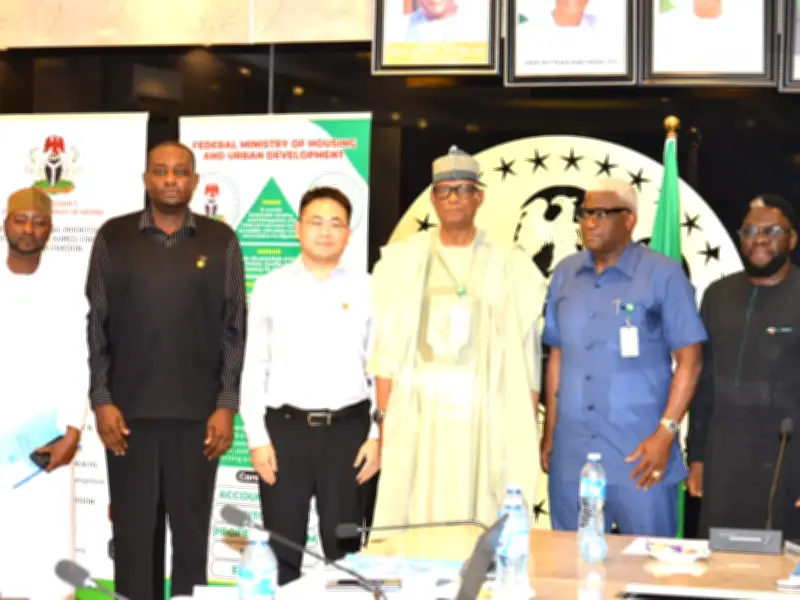
The Federal Government has announced plans to review a proposal submitted by a Chinese construction firm to build 10,000 housing units within 30 months under a Public-Private Partnership (PPP) model. The initiative is part of ongoing efforts to tackle Nigeria's estimated 28 million housing deficit.
Details of the Proposal
According to a statement from the Ministry of Housing and Urban Development, the Chinese firm, identified as China Civil Engineering Construction Corporation (CCECC), presented the proposal to the Minister of Housing and Urban Development, Ahmed Dangiwa, during a meeting in Abuja. The proposal outlines the construction of 10,000 homes across multiple states, with the first phase targeting 5,000 units in the Federal Capital Territory (FCT). The project is expected to be completed within 30 months from the commencement date.
Minister Dangiwa stated that the government would subject the proposal to a thorough review, ensuring it aligns with the National Housing Policy and the Renewed Hope Cities and Estates programme. “We are committed to ensuring that any partnership we enter into benefits Nigerians and meets the standards of affordability and quality we have set,” Dangiwa said.
Government's Stance on PPP Housing
The Federal Government has been actively seeking private sector involvement to bridge the housing gap. Under the PPP framework, the government provides land and regulatory support, while private developers finance and construct the homes. The proposed 10,000 units would be a significant addition to the 100,000 housing units target under the Renewed Hope Cities initiative.
Dangiwa emphasized that the review process would include due diligence on the firm's technical capacity, financial viability, and past projects. “We will not compromise on quality or timelines. This proposal will be scrutinized to ensure it delivers value for money,” he added.
Economic and Social Impact
If approved, the project could create thousands of jobs in the construction sector and stimulate demand for local building materials, contributing to economic growth. The housing deficit in Nigeria is estimated at 28 million units, with over 70% of the population lacking adequate shelter. The government aims to reduce this deficit through a combination of direct construction, mortgage reforms, and PPPs.
Industry experts have welcomed the proposal but cautioned against delays and cost overruns, which have plagued previous housing schemes. “The 30-month timeline is ambitious, but achievable with proper planning and oversight,” said an analyst from the Nigerian Institute of Building.
Next Steps
The Ministry of Housing and Urban Development will set up a technical committee to evaluate the proposal within 60 days. The committee will include representatives from the Federal Ministry of Works, the Bureau of Public Procurement, and the Nigerian Institution of Surveyors. Once approved, construction could begin within the first quarter of 2027.
The Federal Government reiterated its commitment to transparent and accountable partnerships, urging other investors to come forward with similar proposals.