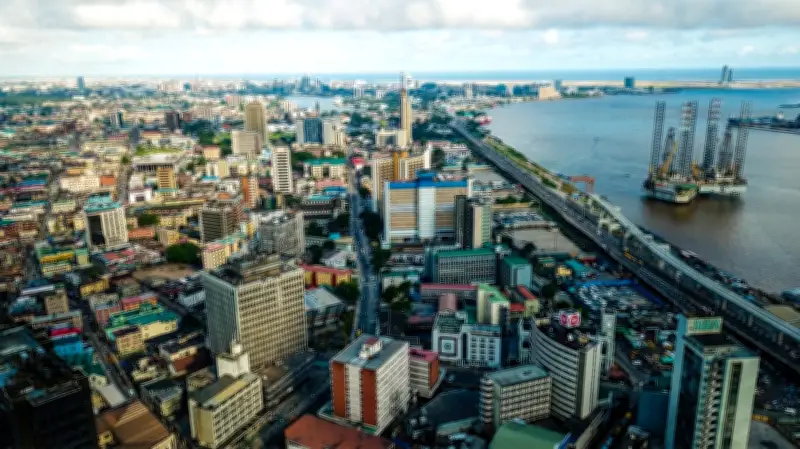
Lagos, Nigeria's commercial capital, is one of the fastest-growing cities in Africa, attracting thousands of new residents each year in search of work, business, and better living conditions. However, building houses in the city has become a complex and costly process, burdened by numerous permits, levies, and charges from various government agencies. Moyosore Salami examines how these multiple regulatory fees are discouraging investment in housing and making accommodation increasingly unaffordable for millions of residents.
Housing Deficit and Inflation
According to the National Bureau of Statistics (NBS), inflation in Nigeria rose to 24.48 per cent in 2025, affecting the cost of building materials such as cement, iron rods, sand, and labour. This has made construction more expensive for developers. Meanwhile, housing demand in Lagos far exceeds supply, with an estimated shortage of about 3.4 million units. Beyond demand and inflation, developers point to the high cost of approvals, permits, and government charges as a major obstacle.
Revenue Generation vs. Housing Budget
Lagos State's 2024 budget allocated a combined revenue target of about N151 billion to the Ministry of Physical Planning and Urban Development and its agencies. The Lagos State Physical Planning Permit Authority (LASPPPA) was assigned N52.5 billion, the Lagos State Building Control Agency (LASBCA) N11.6 billion, Material Testing Laboratory Services N2.163 billion, and the Lagos State Physical Planning and Environmental Monitoring Authority (LASPEMA) N1 billion. In contrast, the state budgeted only N55.92 billion for housing in 2024, meaning planning agencies were expected to generate nearly three times the housing budget. In 2025, Lagos generated about N80 billion from building approval fees between January and May alone, already surpassing the full 2024 housing budget. The 2025 housing budget rose to N101.6 billion, but the five-month approval revenue still represented a significant portion.
Developers' Experiences
For Lagos-based developer Olaoluwa Awolaja, a routine residential project turned into a prolonged process of repeated approvals, rising costs, and delays. He explained that after submitting building plans, developers must obtain a letter of structural stability from registered engineers, undergo inspections at various stages, and secure stage certification approvals. Larger developments require environmental impact assessments, fire service clearance, survey verification, and title documentation, each with its own fees and requirements.
Another developer, Bukola Ojo (not real name), faced similar challenges during a renovation project. Officials halted work until certain levies and documentation were resolved, causing delays that stretched the project from weeks to months. Even after payment, no final inspection was conducted, leaving uncertainty on site. She resorted to pasting the receipt on the wall to prove compliance.
Impact on Tenants
Tenants across Lagos are feeling the burden of rising rents. Blessing Adebayo in Idimu saw her one-bedroom apartment rent jump from N450,000 two years ago to N1.5 million upon renewal. In Ikotun, residents report that rent increases are faster and higher than before, forcing some to leave long-time neighbourhoods. The rising cost of construction and regulatory compliance is passed on to tenants through higher rents.
Approval Bottlenecks
Approval delays within Lagos' building permit system are worsening due to administrative restructuring and the absence of district officers responsible for final approvals. Many applications have been pending for two to three months. The state government is pushing reforms to digitise the approval process, but the transition period has contributed to backlogs. Permit fees may also be reviewed in 2026.
Cost Breakdown
Securing approval for a duplex in Ibeju-Lekki in 2025 costs hundreds of thousands of naira before construction. The official building approval formula includes planning permit fees, layout charges, registration costs, fencing assessment, and Local Purchase Order (LPO) fees. For a typical residential project, the planning permit stage alone costs about N580,000. Developers must also pay LASBCA 20 per cent of the planning permit fee for inspection and stage certification. Construction authorisation costs between N100,000 and N1 million, depending on building type.
General Secretary of the Association of Real Estate Developers of Lagos State (AREDOLS), Ahmad Sanni, listed additional charges: fencing floor charges, layout fees, application fee of N50,000, LPO charges, 100 per cent Special Enhancement fee, 35 per cent Stage Certification fee, five per cent LASEMA levy, Safety Commission charges, and Lagos State Waste Management Authority fees. For larger developments, environmental impact assessments, fire safety certification, survey verification, and title documentation add further costs.
President of the Real Estate Developers Association of Nigeria (REDAN), Akintoye Adeoye, lamented the excessive requirements and exorbitant rates, calling for government engagement. Awolaja noted that regulatory compliance can consume 15 to 25 per cent of total project cost, before considering materials, labour, or financing. The Land Use Charge, an annual property tax, adds to recurring obligations.
Broader Costs
Surveyor Sutoidem Theophilus explained that developers face costs for land acquisition, title perfection, governor's consent, stamp duties, registration fees, planning approvals, environmental requirements, and development levies. They must also provide infrastructure such as drainage, roads, water supply, and alternative power. Professional fees for architects, engineers, and quantity surveyors, along with financing costs, further increase budgets. Informal costs and holding expenses add to the financial pressure, forcing some developers to scale down projects or abandon them.
Legal Perspectives
Real estate lawyer John Ayeomoni noted that developers have access to capital allowances and tax holidays, but rarely pursue disputes through tribunals, preferring lobbying through lawmakers. Lawyer Titilayo Aina-Scott highlighted overlapping charges, with some fees lacking clear legal backing, leading to duplicated inspections and compliance demands. She noted that these complexities raise costs, delay projects, and reduce predictability for investors, particularly affecting affordable housing.
Calls for Reform
Awolaja called for a one-stop shop for all permits, consolidation of overlapping levies, transparency in fee structures, targeted incentives for affordable housing, and full digitisation of the approval process. Aina-Scott echoed these calls, advocating for a single legal framework for development charges, clearer separation of agency functions, and an automatic approval system for missed deadlines. The goal is a more predictable, transparent, and efficient regulatory system to encourage housing investment and ease the burden on developers and tenants alike.