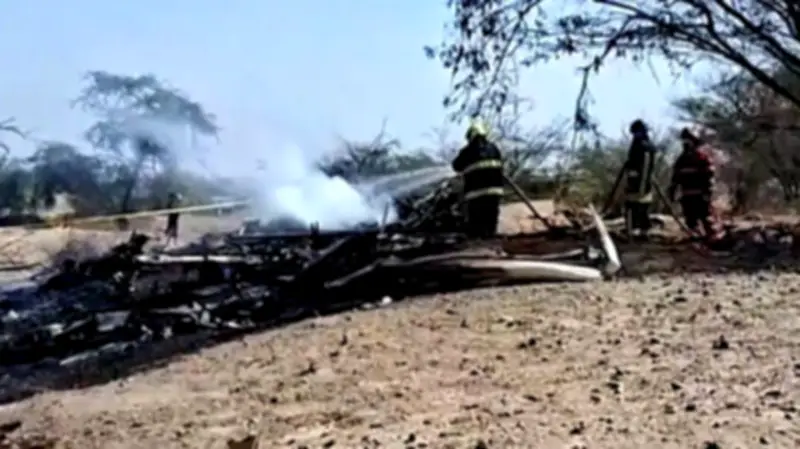
All 13 people on board a sightseeing plane were killed on Saturday when the aircraft crashed into a field on the outskirts of Nazca, a town in southern Peru that is home to the famous Nazca Lines. The plane was carrying European tourists who had joined a scenic flight to view the ancient geoglyphs from the air.
The aircraft had taken off from the nearby city of Ica and was operated by Aerodiana, a Peruvian airline that has been offering aerial tours over the Nazca Lines for the past 14 years, according to Nazca's municipal government.
Airline and aircraft
Aerodiana runs sightseeing flights over the UNESCO-listed Nazca Lines using Cessna Grand Caravan aircraft. The plane involved in the crash was on a routine tourist itinerary, though the exact flight path and time of departure have not yet been released. The cause of the accident remains unknown.
The Nazca Lines are a collection of enormous drawings and geometric shapes etched into the desert centuries ago by the region's indigenous inhabitants. The figures show animals such as monkeys, hummingbirds, and spiders, and they are so vast that they can only be fully appreciated from the air or from specially built observation towers.
The victims
According to Peru's Transportation Ministry, the victims included seven Italian tourists aged between 18 and 54, two Spanish nationals aged 52, and two German tourists aged 77 and 78. The remaining two people on board were the pilot, Américo Salazar, and the co-pilot, Irenka Guanilo del Carpio.
The death toll stands at 13, and there were no survivors. Emergency responders reached the crash site quickly, but the impact was so severe that all on board perished. Authorities have begun the process of notifying the families of the victims, with assistance from foreign embassies.
Government response
Peruvian President Keiko Fujimori expressed deep sorrow over the tragedy and said her administration was considering a temporary suspension of operations at the airport in Nazca. She noted that a final decision would be made after receiving reports from the relevant ministries, including the transport ministry.
The proposed suspension, if implemented, would affect sightseeing flights like the one that crashed. The government has stressed the importance of ensuring aviation safety before resuming such operations.
Investigation into the crash
Peruvian aviation authorities have launched an investigation to determine what caused the plane to crash. The inquiry will look into the aircraft's maintenance records, the pilots' experience, weather conditions at the time, and communication between the cockpit and air traffic control. A preliminary report is expected in the coming weeks.
Aerodiana has not immediately responded to requests for comment, as reported by UNB. The airline has been flying over the Nazca Lines for 14 years without a major incident, but this crash has now put its operational record under scrutiny.
Locals in Nazca are mourning the loss of life, and the town's tourism sector is bracing for the impact. The Nazca Lines are a major attraction, drawing visitors from all over the world. Many local businesses depend on the steady flow of tourists who come to see the geoglyphs, and a tragedy like this could shake public confidence in aerial sightseeing.
While the president has hinted at a possible suspension of airport operations, no immediate shutdown has been announced. The final decision will hinge on the findings of the investigation and the recommendations of expert teams.
This incident is a stark reminder of the risks of small-plane travel in remote desert regions, where weather can be unpredictable and terrain challenging. For the families of the 13 people who lost their lives, the crash is a devastating loss. For Peru, it is a moment of national mourning and a time for reflection on how to make such tours safer.