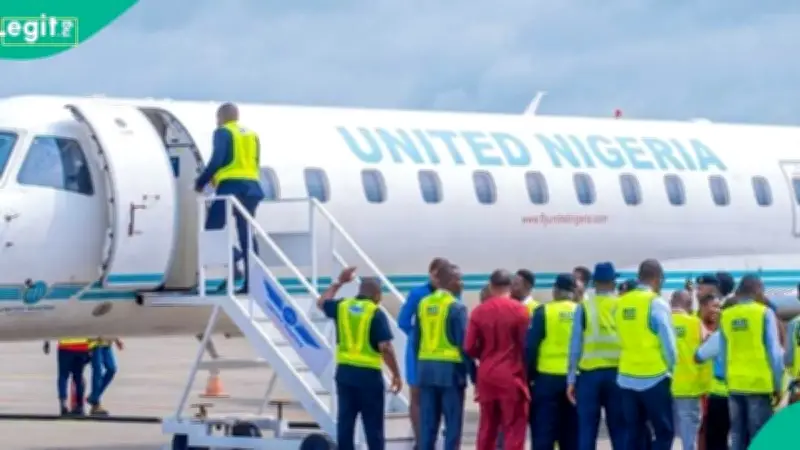
United Nigeria Airlines has secured approval from the Federal Government to operate four to five new international routes, including New York, Canada, and Dubai. The announcement was made on Thursday, June 18, in Lagos by the Minister of Aviation and Aerospace Development, Festus Keyamo, who emphasized that the move is part of a broader strategy to strengthen Nigerian-owned carriers in the global aviation market and reduce dependence on foreign airlines.
Government Aims to Reverse Foreign Dominance
Keyamo stated that Nigerian airlines currently carry only about 5% to 10% of outbound passengers, while foreign carriers dominate the remaining 90% to 95%. He said the government is now working to reverse this imbalance through policy reforms and strategic route allocation. “We are giving United about four or five routes now. We are giving them New York. We are giving them Canada. We are giving them Dubai. We are giving them some very fruitful routes now,” Keyamo said.
The minister noted that under bilateral air service agreements, Nigerian airlines are entitled to operate reciprocal international routes but have not fully capitalized on these opportunities in the past. The new approvals are intended to correct that.
Fleet Expansion and Financing Support
During the announcement, the airline also unveiled two newly acquired Boeing 737-800NG aircraft, signaling its commitment to expanding long-haul capacity. Keyamo revealed that President Bola Tinubu has approved the creation of a Nigerian aircraft leasing company to help domestic carriers access modern aircraft more easily. He added that the government is partnering with Abia State to build an international airport, which United Nigeria Airlines is expected to use as a hub, while Enugu International Airport is being positioned as a cargo hub.
Keyamo highlighted that the route approvals are part of wider aviation reforms aimed at reducing flight delays, cancellations, and operational pressure. He also referenced past challenges, including multiple court cases involving airlines and regulators, but said recent reforms are now beginning to yield results after about two and a half years.
Private Sector Model Preferred
The minister explained that the government has adopted a private-sector-led model rather than reviving a national carrier, citing the collapse of Nigeria Airways as an example of poor state management in aviation. He compared Nigeria’s approach with successful global airlines such as Ethiopian Airlines, Lufthansa, and British Airways, noting that strong governance and operational independence are key drivers of success.
Keyamo expressed confidence that the new routes and fleet expansion would enable United Nigeria Airlines to compete effectively with foreign carriers and contribute to the growth of Nigeria’s aviation sector.
Job Opportunities Announced
Earlier, United Nigeria Airlines announced new job vacancies across multiple departments as part of its expansion. The airline is inviting qualified professionals to apply for roles including lead, strategic partnerships, growth and planning manager, and human resources officer.