
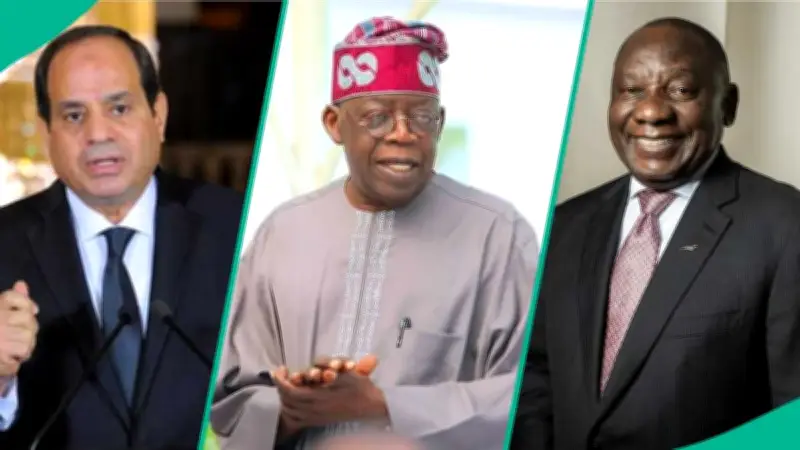
The International Monetary Fund (IMF) has released its latest projections for Africa's largest economies in 2026, based on nominal GDP estimates. The rankings show that while traditional heavyweights like South Africa, Egypt, and Nigeria maintain their positions, countries such as the Democratic Republic of Congo and Ethiopia are experiencing rapid growth, signaling a gradual shift in the continent's economic landscape.
Top 10 Richest Economies in Africa for 2026
1. South Africa — $479.96 billion
South Africa remains Africa's largest economy with an estimated GDP of nearly $480 billion. The country benefits from a sophisticated financial system, developed capital markets, and diversified industries including mining, manufacturing, telecommunications, and services. Despite challenges such as electricity shortages, rail and port inefficiencies, and sluggish economic growth, South Africa retains a competitive advantage due to its economic complexity and deep corporate sector. Recent investment conferences have attracted billions of dollars in pledges, though converting these commitments into actual projects remains a challenge.
2. Egypt — $429.65 billion
Egypt holds second place with a GDP of $429.65 billion. The North African nation has benefited from large-scale infrastructure projects, investments around the Suez Canal Economic Zone, a growing energy sector, and a recovery in tourism. Economic reforms supported by international lenders have helped strengthen public finances, although inflationary pressures and currency weakness continue to weigh on households and businesses. Egypt remains one of Africa's most diversified economies.
3. Nigeria — $377.37 billion
Nigeria remains Africa's third-largest economy and the continent's most populous country, with a GDP estimated at $377.37 billion. Recent economic reforms, including foreign exchange market liberalization and fiscal adjustments, have contributed to improved investor confidence. However, inflation, exchange-rate volatility, infrastructure deficits, and dependence on oil revenues continue to pose significant challenges. Recent upgrades from international rating agencies reflect optimism about Nigeria's medium-term outlook, particularly as domestic refining capacity expands and oil production improves.
4. Algeria — $317.17 billion
Algeria ranks fourth with a GDP exceeding $317 billion. Hydrocarbon exports remain the backbone of the economy, accounting for a significant share of government revenues and export earnings. The government has stepped up efforts to diversify into manufacturing, agriculture, and renewable energy, though progress has been gradual. Strong energy prices in recent years have helped support economic stability and public spending.
5. Morocco — $194.33 billion
Morocco continues to strengthen its position as one of Africa's most diversified economies. With GDP projected at $194.33 billion, the country benefits from robust tourism, agriculture, and a rapidly growing manufacturing sector. Morocco has become a major hub for automotive and aerospace production, attracting investment from European and global manufacturers. Strategic infrastructure projects and trade links with Europe have further boosted its economic resilience.
6. Angola — $152.35 billion
Angola remains one of Africa's leading oil producers, with GDP projected at $152.35 billion. Revenue from crude exports continues to drive economic activity, while government reforms aimed at improving fiscal discipline and attracting foreign investment are gradually yielding results. The country's long-term challenge remains reducing its heavy dependence on oil by expanding sectors such as agriculture, mining, and manufacturing.
7. Kenya — $147.26 billion
Kenya retains its status as East Africa's largest economy, with GDP estimated at $147.26 billion. The country has built a reputation as a regional hub for finance, technology, logistics, and innovation. Nairobi's thriving startup ecosystem, strong banking sector, and growing digital economy continue to support growth, alongside agriculture, which remains a major employer and export earner.
8. DR Congo — $123.41 billion
The Democratic Republic of Congo records one of the fastest growth rates among Africa's major economies, reaching a GDP of $123.41 billion. The country's enormous reserves of cobalt and copper—critical minerals used in electric vehicles, batteries, and renewable energy technologies—have attracted increasing global interest. Nevertheless, political instability, insecurity in parts of the country, and governance challenges continue to threaten long-term development.
9. Ethiopia — $121.53 billion
Ethiopia returns to the top ten with a GDP of $121.53 billion. After years of rapid expansion followed by setbacks caused by internal conflict, the economy is gradually regaining momentum. Government investments in infrastructure, industrial parks, and manufacturing, combined with a large domestic market of more than 130 million people, continue to underpin growth. IMF projections suggest Ethiopia remains one of Africa's most promising long-term growth stories.
10. Ghana — $118.29 billion
Ghana rounds out the top ten with a GDP of $118.29 billion. The West African economy continues to rely heavily on exports of gold, cocoa, and oil. Although the country has faced debt and fiscal pressures in recent years, reforms under an IMF-supported programme have helped improve macroeconomic stability. Analysts expect these measures to support stronger growth over the coming years.
Côte d'Ivoire Drops Out Despite Strong Growth
One of the biggest surprises in this year's ranking is Côte d'Ivoire. The country was among Africa's ten largest economies in 2025, with a GDP of about $109.89 billion. However, despite recording strong growth of more than 13% and expanding to approximately $112.12 billion, it narrowly missed out on a place in the 2026 top ten. This development highlights the increasingly competitive nature of Africa's economic landscape, where several countries are expanding simultaneously and vying for greater influence on the continent.
A Continent in Transition
The latest IMF projections show that Africa's economic power remains concentrated in a handful of countries, with South Africa, Egypt, Nigeria, Algeria, and Morocco accounting for more than half of the continent's total GDP. Yet the rapid rise of economies such as DR Congo, Ethiopia, and Côte d'Ivoire suggests that Africa's growth story is becoming more diversified. As governments pursue reforms, industrialization, and infrastructure development, the continent's economic rankings could look significantly different over the next decade.




