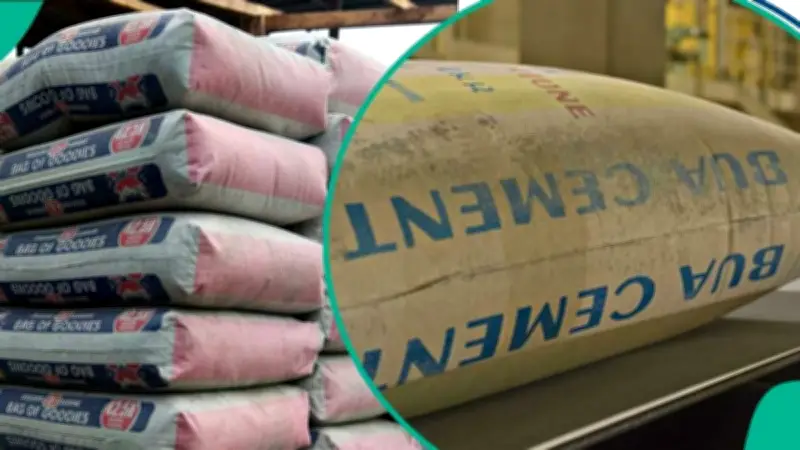
The Federal Competition and Consumer Protection Commission (FCCPC) has concluded a three-month investigation into Nigeria’s cement market, uncovering concerns over sharp price increases despite the country’s substantial production capacity. The probe, announced on Tuesday, August 18, 2026, revealed that cement prices climbed to as high as N15,000 per 50kg bag by July, prompting major manufacturers like Dangote Cement and BUA Cement to review their pricing strategies.
Investigation Findings and Market Concerns
The FCCPC’s preliminary findings, detailed in a 40-page field report from its Anticompetitive Practices Department, followed complaints about the high cost of cement. The Commission noted that all major cement manufacturers made their records available except one. Publicly available estimates indicate that three major operators control more than 90 per cent of Nigeria’s installed cement production capacity.
According to the FCCPC, market intelligence showed cement prices rising from about N9,300-N9,700 per 50kg bag in January to N10,500-N13,000 by mid-year, before reaching N13,000-N15,000 in some locations by July. This price surge occurred despite Nigeria’s installed production capacity estimated at more than 60-65 million metric tonnes annually, compared with domestic consumption of about 25-30 million tonnes. The country is also a net exporter of cement to neighbouring markets.
Comparison with Other African Markets
The FCCPC expanded its investigation to include cement markets in Kenya, Tanzania, South Africa, Egypt, Morocco, and Algeria. Its findings showed that a 50kg bag of cement sells for about $5.40 (N7,344) in Kenya and $4.80 (N6,528) in Tanzania. In Togo, where there are no limestone deposits, the price was about $6.75 (N9,180). These comparisons have intensified concerns over whether production costs and other market conditions fully explain Nigeria’s higher prices.
The FCCPC said such significant excess capacity would ordinarily be expected to create competitive pressure and help moderate prices. Instead, prices have continued to rise, prompting deeper scrutiny of the industry.
FCCPC Seeks Answers from Manufacturers
FCCPC Executive Vice Chairman and CEO, Tunji Bello, said the investigation was necessary because cement prices directly affect housing, commercial property development, infrastructure, and the wider cost of doing business. He stressed that the Commission was not seeking to dictate how companies operate but to establish whether the market is functioning competitively and whether consumers are benefiting.
The FCCPC has issued Notices of Commencement of Investigation and Summons to Produce to key industry players. The manufacturers are expected to provide information on pricing methods, production, capacity utilisation, exports, and commercial relationships. The next phase will determine whether current prices are justified by legitimate costs and market conditions or whether there is evidence of coordinated pricing, abuse of market power, restricted domestic supply, or other anti-competitive practices.
If violations are established, the investigation could trigger stronger regulatory action in an industry whose prices have a direct impact on the cost of building homes and infrastructure across Nigeria.
Top Cement Makers Post Strong Earnings
Legit.ng earlier reported that Nigeria's three largest listed cement manufacturers—Dangote Cement, BUA Cement, and HBM Nigeria—reported robust first-half 2026 earnings, driven by higher sales volumes, improved operational efficiency, and a more stable foreign exchange environment. The sharp increase in cement prices, from between N9,300 and N9,700 per bag in January to an average of N10,500 to N13,000, also played a significant role in boosting the companies' revenues and profitability. The outcome of the FCCPC investigation could determine whether these pricing trends continue or face regulatory intervention.