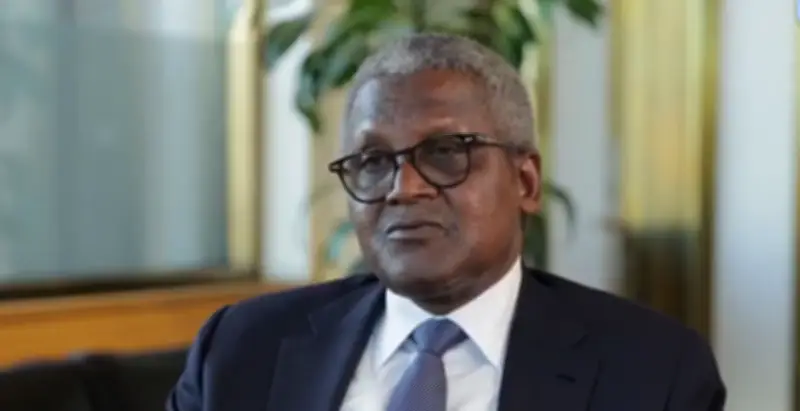
Dangote Group, the conglomerate owned by Africa's richest man Aliko Dangote, has offered a 30 per cent holding in its proposed 700,000 barrel-per-day (bpd) refinery to nations in East Africa, the region where the mega crude-processing plant is to be located, Bloomberg reported on Friday.
Kenya to Take 10% Stake in Lamu Refinery
Kenya, where the new refinery will be sited at the southeastern coastal town of Lamu, will take a 10 per cent stake estimated at around half a trillion dollars, David Ndii, a top economic adviser of President Ruto, told Bloomberg. Ndii made the remarks at a capital market conference in Nairobi on Thursday.
“The total for the region is about $1.5 billion. I don’t actually see a challenge in doing that, and if some of them are not off-taking we will backstop,” Mr Ndii was quoted as saying. Ethiopia and Rwanda are said to have indicated willingness to participate in the project.
Dangote Expands After Nigerian Refinery Struggles
Mr Dangote is turning to business-friendly Kenya and other promising markets in East Africa to expand his multi-billion dollar empire after facing an avalanche of resistance from his home country Nigeria in bringing a refinery of similar capacity to completion. The Nigerian refinery, situated on the outskirts of Lagos and initially projected to be completed in 2016, did not see the light of the day until eight years later, held back by logistic delay, infrastructure constraints and COVID-19 lockdowns.
The magnate, who has built his fortune around cement, sugar and a couple of fast-moving consumer products, accused international oil companies of sabotaging efforts at getting the Nigerian refinery running seamlessly in its early days. He claimed that the Nigerian Midstream and Downstream Petroleum Regulatory Authority, which serves as the top watchdog for the midstream and downstream segments of the oil industry, issued new licences to some players to import “dirty fuel” as part of a broader conspiracy to frustrate his push to wean Nigeria off its longstanding dependency on fuel imports.
Leadership Changes Amid Refinery Crisis
In the heat of the crisis, Farouk Ahmed, the CEO of the regulator at the time, resigned his appointment, while Mele Kyari, the immediate past managing director of state oil company NNPC Limited, whom Mr Dangote accused of surreptitiously running a fuel blending plant off the coast of Malta, was shown the exit door. “I knew there would be a fight. But I didn’t know that the mafia in oil, they are stronger than the mafia in drugs,” he told an investment conference in June 2024.
A private placement, which raised $2.5 billion ahead of the Nigerian refinery’s planned $5 billion initial public offer scheduled for October, valued the refinery at $40 billion. The private equity capital raise was 3.7 times, drawing interest from African institutional investors and institutional investors from outside the continent.
Kenyan Refinery to Boost Capacity to 1.4 Million bpd
The groundbreaking of the Kenyan refinery is expected to kick off next month. That puts the company on course to achieve the ambition of doubling its refining capacity to 1.4 million bpd in the next three years, with processing capacity at the refinery in Lagos already upped to 700,000 bpd from its original 650,000 bpd. The planned refinery in Kenya is expected to cost $15 billion to $17 billion.