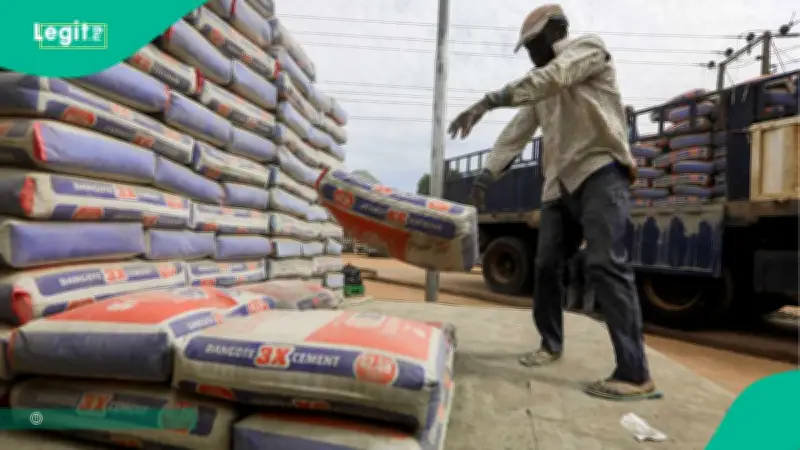
The Federal Competition and Consumer Protection Commission (FCCPC) has opened a major investigation into Nigeria's cement industry, questioning why prices remain significantly higher than in several other African countries despite the country's huge limestone reserves and substantial production capacity. The commission has summoned major cement manufacturers, including leading industry players, as it examines whether the current price of cement is being driven by genuine production costs or possible anti-competitive practices.
The investigation follows widespread complaints from consumers, builders, and businesses over the sharp increase in the cost of cement, a product that directly affects housing, infrastructure, and construction costs across Nigeria. According to the FCCPC's preliminary findings, a 50-kilogramme bag of cement sold for between N9,300 and N9,700 in January 2026. By the middle of the year, prices had climbed to between N10,500 and N13,000. By July, the commission said some markets were recording prices as high as N13,000 to N15,000 per bag.
Nigeria's Cement Price Compared with Other Countries
The FCCPC said its three-month cross-border study found a striking difference between Nigerian cement prices and those in other African markets. In Nairobi, Kenya, a 50kg bag sold for about N7,344, while the equivalent price in Tanzania was approximately N6,528. In Togo, where the country does not have significant limestone deposits, a 50kg bag was reportedly selling for about N9,180. The commission said the comparison raised important questions because Nigeria has significant limestone resources, large-scale cement plants, and considerably higher installed production capacity. The study examined cement markets in Kenya, Tanzania, and South Africa, as well as Egypt, Morocco, and Algeria.
Nigeria Has Huge Production Capacity
The FCCPC estimates that Nigeria has an annual cement production capacity of between 60 million and 65 million metric tonnes, while domestic consumption stands at about 25 million to 30 million metric tonnes. This means the country has substantial excess installed capacity. Nigeria is also a net exporter of cement to neighbouring countries, according to the commission. The FCCPC said the combination of excess capacity and domestic production should ordinarily create stronger competition among manufacturers and exert downward pressure on prices. Instead, consumers have continued to face rising prices. The commission said this disconnect was one of the reasons it decided to deepen its investigation into the industry.
Manufacturers Explain Rising Costs
Cement manufacturers have attributed the price increases to several factors, including higher energy costs, the depreciation of the naira, expensive imported machinery and spare parts, and transportation and logistics expenses. However, the FCCPC said it was testing these explanations against verified data on production costs, capacity utilisation, pricing structures, and broader market conditions, according to a report by Leadership. The commission said it would determine whether the current prices could reasonably be justified by legitimate business costs. It will also investigate possible coordination among manufacturers, abuse of market power, restrictions on domestic supply, and anti-competitive distribution practices.
Dangote, BUA, and Others Face Scrutiny
As part of the investigation, the FCCPC has issued Notices of Commencement of Investigation and Summons to Produce to key companies in the cement sector. The manufacturers have been directed to provide records covering their pricing methods, production volumes, capacity utilisation, exports, and commercial relationships. The commission said most major manufacturers had cooperated by granting access to their records, although one company had yet to do so. Publicly available estimates indicate that three major cement producers account for more than 90 per cent of Nigeria's installed cement production capacity, highlighting the importance of competition within the sector.
FCCPC Executive Vice-Chairman and Chief Executive Officer, Tunji Bello, said the investigation was not an attempt to dictate how companies should operate or prevent them from making profits. Instead, he said the commission was seeking to establish whether the market was functioning competitively and whether Nigerian consumers were benefiting from effective competition. Bello stressed that businesses were entitled to make legitimate commercial decisions and earn returns on their investments. However, he said competition law was designed to ensure that prices, production, and other market outcomes were driven by genuine competition rather than practices that unlawfully restrict it. With cement prices reaching as high as N15,000 in parts of Nigeria, the FCCPC's investigation could have significant implications for manufacturers, builders, property developers, and millions of Nigerians struggling with the rising cost of housing.