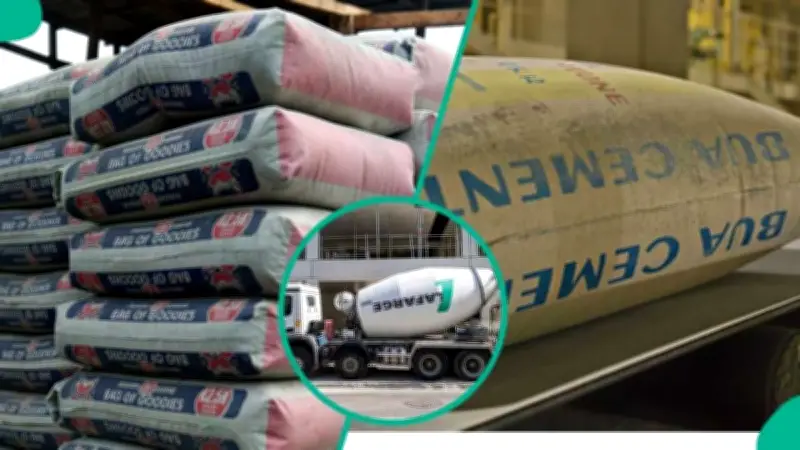
Chinese-owned HBM is intensifying its competition with Dangote Cement and BUA Cement for a larger share of Nigeria's cement market, launching an aggressive distributor recruitment drive as production capacity expands and retail prices remain as high as ₦15,000 per 50kg bag. The company is asking prospective distributors to provide at least ₦250 million in working capital, a 500-square-metre warehouse, and access to five 20-tonne or 40-tonne trucks.
HBM's Distributor Recruitment Drive
HBM, formerly Lafarge Africa, is seeking to strengthen its distribution network ahead of additional production capacity. The recruitment drive comes as Nigeria's three listed cement manufacturers—Dangote Cement, BUA Cement, and HBM—compete for dominance in a market where prices have more than doubled since 2023.
According to Proshare's computation from the half-year 2026 financial statements, Dangote Cement accounted for 56.2% of the Nigerian revenue recorded by the three companies. BUA Cement accounted for 22.7%, while HBM stood close behind at 21.1%. These figures represent shares of the companies' reported Nigerian revenue rather than volume-based market shares and may also reflect differences in pricing and product mix.

Cement Prices More Than Double
The competition comes at a sensitive time for Nigerian builders and prospective homeowners. A 50kg bag of cement currently retails for between ₦12,500 and ₦15,000, compared with about ₦5,500 to ₦6,000 in 2023. At the midpoint of the current range, 100 bags would cost approximately ₦1.375 million, compared with around ₦575,000 using the midpoint of the 2023 range.
That represents an additional ₦800,000 for just 100 bags, putting further pressure on construction costs amid Nigeria's housing deficit of more than 16 million units.
Expanding Capacity and Market Imbalance
HBM is expanding its installed production capacity from 10.5 million tonnes per annum to 14 million tonnes through projects at Sagamu and Ashaka. That additional capacity will require an expanded distribution network capable of moving significantly more cement into Nigerian markets.
Nigeria's installed capacity across the three producers currently stands at about 62.75 million tonnes annually, while estimated domestic consumption is only 25 million to 30 million tonnes. Announced expansion projects could push capacity to approximately 75.25 million tonnes, meaning Nigeria could eventually have installed capacity equivalent to roughly two-and-a-half to three times estimated current domestic consumption.
Yet retail cement prices remain between ₦12,500 and ₦15,000 per bag. The analysis estimates Nigerian cement prices at roughly 2.16 times the midpoint average across Ghana, Kenya, South Africa, and Egypt, although differences in exchange rates, taxes, product specifications, and delivery structures make direct comparisons difficult.
Distributor Requirements and Costs
HBM's recruitment requirements have changed significantly from Lafarge Africa's 2020 distributor recruitment, which required cement-market knowledge, proof of financial net worth, and limits on borrowed capital. The latest HBM offer places greater emphasis on access to capital, warehousing, and transportation, while successful applicants will pass through a Business Development Academy.
Despite the headline ₦250 million requirement, the analysis estimates that a distributor purchasing warehouses and trucks could ultimately require between ₦595 million and ₦1.25 billion. At an assumed ex-works cement price of ₦8,500 per bag, ₦250 million would purchase approximately 29,400 bags, equivalent to about 1,471 tonnes.
Impact on Prices and Regulatory Scrutiny
The expanding production capacity leaves manufacturers with a crucial challenge: finding buyers for additional output. Public infrastructure projects, housing construction, and exports could absorb some of the production. Dangote Cement's Nigerian cement and clinker exports, for example, rose 62.3% to 1.1 million tonnes in the first half of 2026.

But greater domestic competition could also increase pressure on manufacturers and distributors to improve availability and compete on delivered prices. For millions of Nigerians struggling with construction costs, that is ultimately the bigger question surrounding HBM's latest move: whether an increasingly fierce battle among Dangote, BUA, and their Chinese-owned rival will eventually translate into cheaper cement at the retail end.
Legit.ng earlier reported that the Federal Competition and Consumer Protection Commission (FCCPC) has deepened its scrutiny of Nigeria's cement industry as the price of a 50kg bag climbs beyond ₦15,000 in some locations. The regulator has issued formal Notices of Commencement of Investigation and Summons to Produce to major cement manufacturers, including Dangote Cement, BUA Cement, and HBM Nigeria.