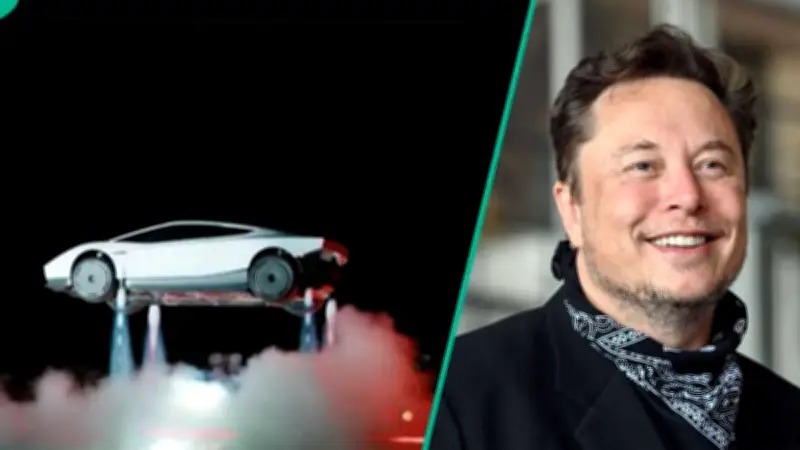
Tesla has unveiled a prototype of its next-generation Roadster sports car that uses rocket technology to briefly lift off the ground, with Elon Musk saying the company plans to begin production in 2028.
The demonstration took place on Thursday, October 15, at a SpaceX testing facility in Texas, United States, where the two-seater vehicle performed several manoeuvres, including driving upside down before making a short airborne movement. No driver was inside the car during the test.
Rocket Technology and Performance Claims
Musk said the decision to test without a driver was deliberate, “to make sure we don’t kill anyone.” He added: “Success is not guaranteed. I mean that. It’ll probably work, but if it doesn’t work, we’re at a safe distance.”
CNN reported that the car relies on 10 nozzles and high-pressure air tanks to produce thrust. Musk also claimed the Roadster could accelerate from zero to 60 miles per hour in less than a second.
The project brings together Tesla, the electric vehicle company, and SpaceX, Musk’s rocket firm. Musk described the development as “the results of what happens when you have a collaboration with the world’s best car company and the world’s best rocket company.”
Addressing Scepticism
Musk also addressed scepticism among spectators, saying the live audience could confirm that the demonstration was genuine. He said: “We need an audience to prove that it’s not AI or SI. So you guys can tell people you saw it with your eyes, because what you see with your eyes, you will not believe.”
Despite the demonstration, some aviation specialists have questioned whether the vehicle can achieve sustained flight or become a practical flying car.
Roger Conner, curator for vertical flight at the Smithsonian’s National Air and Space Museum, told CNN that engineering a vehicle capable of operating on roads and in the air presents significant challenges, Punch reports. He said: “Aircraft are extremely sensitive to weight, whereas with ground vehicles you want them to have bumpers and crumple zones and all that.”
Production Timeline and Remaining Questions
Musk has set 2028 as Tesla’s target year to begin production of the new Roadster. However, the prototype has yet to demonstrate sustained flight or establish its practicality as a vehicle capable of operating reliably on roads and in the air.
Questions also remain about safety, engineering requirements and the cost of bringing the technology to market.
Earlier, Legit.ng reported that Neuralink, the neurotech startup co-founded by Elon Musk, has received approval from the Food and Drug Administration (FDA) USA to conduct its first clinical trial of installing microchips in humans. The approval is a significant milestone for Neuralink, which aims to develop brain implants that can decode neural signals and connect them to computers. The brain implant, called the Link, is designed to assist patients with severe paralysis in controlling external technologies solely using neural signals.