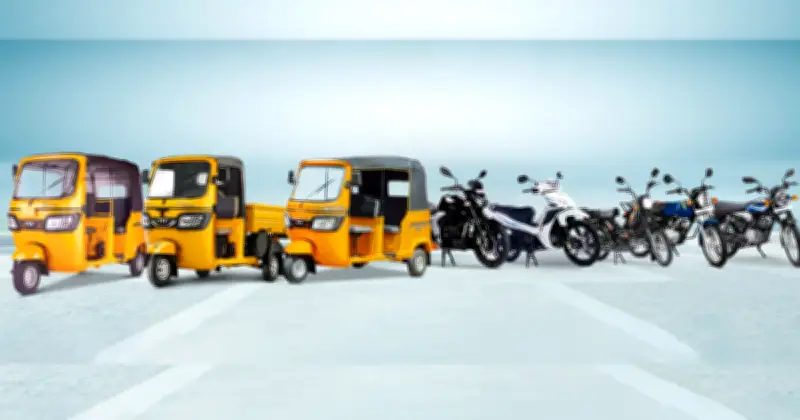
TVS Motor Company is actively serving Nigeria's expanding mobility market with a portfolio that includes the HLX and Neo NX motorcycles, as well as the TVS King passenger and cargo three-wheeler, supported by a local sales, service and spare-parts network. The company's global manufacturing scale, which ranked it as the world's third-largest two-wheeler manufacturer based on calendar-year 2025 wholesale volumes, underpins its local proposition.
Two- and Three-Wheelers Fill a Critical Gap in Nigeria's Transport Mix
Nigeria's mobility market extends well beyond cars, buses, and rail, with a considerable amount of economic activity taking place between those systems. A trader moving stock from a wholesaler to a shop, a technician travelling to a customer, a delivery rider crossing town, or a small business making several local drop-offs in a day all rely on two- and three-wheelers as an established part of the transport mix. For these journeys, where time, access and operating cost matter, these smaller vehicles have become indispensable.
The demand for smaller vehicles is not uniform. A commuter has different priorities from a commercial rider, just as a trader moving goods has different requirements from a passenger operator. A business making frequent deliveries may need a vehicle that can cover local routes efficiently, while a technician or salesperson may simply need dependable mobility that allows more customer visits within the working day. The same consideration applies to three-wheelers: a passenger model can support short shared journeys, while a cargo variant gives traders and small businesses more capacity to move goods without immediately taking on the cost of a larger commercial vehicle.
Local Partnerships Strengthen After-Sales Support and Productivity
In both cases, the vehicle is being used as part of an economic activity, which makes what happens after purchase almost as important as the initial transaction. In Nigeria, TVS works with the Simba Group and Enviable Tricycle Auto Limited, with the local structure supporting sales, service and access to spare parts. For an operator whose vehicle is expected to earn its keep, that support can influence the real value of the purchase. A vehicle that can be serviced and maintained with the appropriate parts has a better chance of remaining productive over its working life.
The local proposition sits within considerable manufacturing capacity. Industry reporting based on calendar-year 2025 wholesale volumes ranked TVS as the world's third-largest two-wheeler manufacturer. Its global product range spans several vehicle categories and markets, including commuter, sports and adventure motorcycles, scooters, mopeds and electric vehicles. For customers in Nigeria, the relevance of that scale is less about the ranking itself than the experience represented by a manufacturer that produces across different segments rather than relying on a single model or use case.
Beyond Passenger Transport: Two-Wheelers as Economic Assets
That breadth has become even more important as the role of two-wheelers in Nigeria continues to extend beyond their traditional association with commercial passenger transport. The same category can serve as a personal commuter vehicle, a delivery tool, a means for a technician or salesperson to cover more ground, or a working asset for a small business that needs to reach customers without the cost of a larger vehicle. For those customers, the argument for adoption is therefore not simply that two-wheelers cost less than cars, but the real value comes from the amount of work they enable. A motorcycle that allows a salesperson to make more visits in a day, or a cargo three-wheeler that allows a retailer to move stock between locations, is contributing directly to the productivity of the person or business using it.
There is an ecosystem around that activity as well. Motorcycles and three-wheelers create demand for technicians, spare-parts suppliers, service personnel and operators, while changes in vehicle technology bring new maintenance and technical requirements. TVS's international portfolio already includes electric vehicles alongside conventional motorcycles and other mobility formats, giving the company experience across a wider range of mobility technologies.
Manufacturing Scale and Proven Products Meet Local Needs
None of this makes smaller vehicles a substitute for public transport. Nigeria will continue to require buses, rail, better roads and more integrated transport systems. Two- and three-wheelers serve a different part of that network, particularly for shorter journeys, local distribution and trips where a larger vehicle may not be the most practical option. That is why the discussion around adoption is gradually moving beyond the simple question of whether Nigerians will use two-wheelers. They already do. The more relevant question is which products can meet different needs reliably, and which manufacturers can support customers after they make the purchase.
TVS enters that consideration with an established Nigerian portfolio, an HLX that has crossed five million cumulative global sales, global manufacturing scale and local partners supporting sales, service, and spare-parts access. For a market where mobility and commerce are closely connected, these capabilities give consumers and businesses more reasons to look at two- and three-wheelers not simply as a means of getting from one place to another, but as practical assets for work, personal mobility and everyday economic activity.