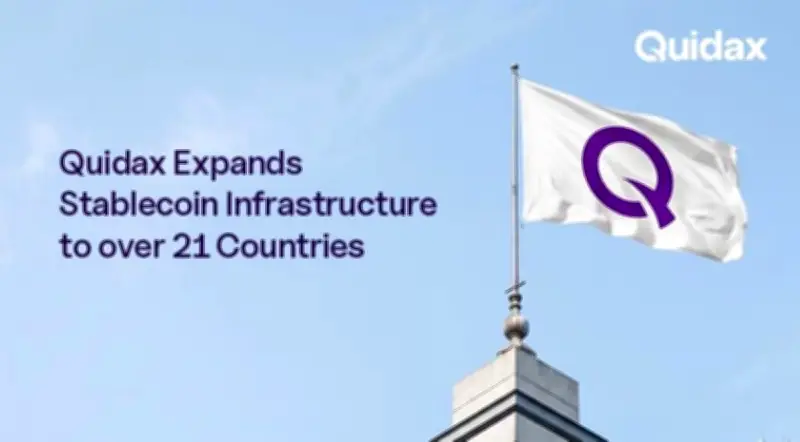
Nigeria's first Securities and Exchange Commission (SEC)-licensed cryptocurrency exchange, Quidax, has announced the expansion of its stablecoin infrastructure to over 21 countries. The move positions the exchange as a key player in facilitating cross-border payments and remittances across Africa and beyond.
Expansion Details and Reach
According to a company statement, the expansion covers markets in Africa, Europe, and Asia, including Ghana, Kenya, South Africa, the United Kingdom, and the United Arab Emirates. Quidax's stablecoin infrastructure now supports transactions in multiple fiat currencies, enabling users to send and receive stablecoins like USDT and USDC with reduced fees and faster settlement times.
The exchange reported facilitating over $1 billion in transactions in the past year, with stablecoin usage accounting for a significant portion. 'Our goal is to make stablecoins accessible to everyone, especially in regions with limited banking infrastructure,' said Buchi Okoro, CEO of Quidax. 'This expansion brings us closer to a world where financial transactions are instant, cheap, and borderless.'
Regulatory Milestone and Impact
Quidax gained its SEC license in 2022, becoming the first Nigerian exchange to receive regulatory approval. This has boosted user confidence and allowed the exchange to expand services. The new stablecoin infrastructure is part of a larger strategy to promote financial inclusion, reducing reliance on traditional banking channels for remittances, which cost Nigerians an estimated $500 million annually in fees.
'By leveraging stablecoins, we can slash transaction costs by up to 50% compared to traditional methods,' Okoro added. The infrastructure also includes on-ramp and off-ramp solutions, allowing users to convert naira and other local currencies to stablecoins seamlessly.
Partnerships and Technical Integration
To achieve this expansion, Quidax partnered with several fintech firms and blockchain protocols, including Stellar and Binance Smart Chain. The integrations enable interoperability across different networks, reducing friction for users. Additionally, Quidax has launched a new API for businesses, allowing merchants to accept stablecoin payments directly.
The move is expected to spur adoption in countries with high remittance dependence. For instance, in Ghana, where remittance inflows exceeded $4 billion in 2025, Quidax's infrastructure could provide a cheaper alternative. Similarly, in Kenya, mobile money users can now top up their wallets via stablecoins through Quidax's platform.
Future Plans
Quidax plans to expand to 50 countries by the end of 2027, with a focus on emerging markets. The company is also exploring the launch of its own stablecoin, pegged to the naira, to further localize services. 'We are building the backbone for a new financial system,' Okoro concluded.