
The link between housing and economic growth is rarely given the attention it deserves, but for Nigeria, the choice is stark: build homes or build an economy. As the country sets its sights on a US$1 trillion GDP, the housing sector is emerging as a critical lever that could either accelerate or stall that ambition.
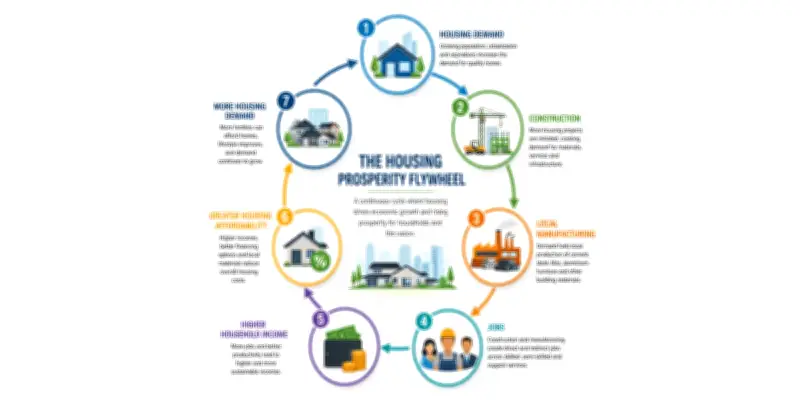
Housing is not just about shelter. It is a job creator, an industrial catalyst, and a financial stabilizer. Every home built triggers demand for cement, steel, labor, logistics, and financing, touching dozens of sectors and creating a ripple effect that can be felt across the entire economy.
Housing as an Economic Multiplier
The construction industry is one of the most labor-intensive sectors in any economy. In Nigeria, where unemployment remains a persistent challenge, a robust housing program could provide millions of direct and indirect jobs, from masons and carpenters to engineers and property managers. These jobs would not only reduce poverty but also boost disposable income and consumer spending.
Moreover, housing development stimulates local industries. Building materials, furniture, electronics, and even textiles all benefit from a booming real estate market. This multiplier effect is well-documented in other emerging economies, yet Nigeria has been slow to harness it.
Addressing the Housing Deficit
Nigeria faces a severe housing shortage, with the deficit estimated in the millions of units. The gap between supply and demand grows wider each year, as population increases and urban migration continues. Tackling this deficit is not just a social obligation but an economic necessity.
Public-private partnerships have been proposed as a solution, but progress has been limited by bureaucratic bottlenecks, land administration issues, and a lack of affordable financing. Without a coherent national housing strategy, these challenges will persist, and the economic potential will remain untapped.
Policy Reforms That Could Turn the Tide
Experts argue that a sustainable housing strategy must include several key elements. First, simplified land title registration would make it easier for developers to acquire and develop property. Second, tax incentives for affordable housing projects could attract private investment. Third, the development of mortgage infrastructure would enable more Nigerians to finance their homes.
At the same time, the government must invest in basic infrastructure such as roads, power, and water in housing estates. Without these, the value of new homes is limited, and the economic impact is diminished. Coordination between federal, state, and local governments is essential to ensure that housing projects are not isolated but part of a larger urban development plan.
The Trillion-Dollar Opportunity
If Nigeria can align its housing strategy with its economic targets, the payoff could be enormous. A thriving construction sector would contribute directly to GDP growth, while the ancillary industries would multiply the effect. Moreover, a well-housed population is more productive, healthier, and more stable, reducing the social costs that often drag on the economy.
Conversely, if the housing sector remains neglected, Nigeria will miss out on a powerful driver of growth. The path to a US$1 trillion economy is not just about oil prices or foreign investment; it is about building the domestic foundation that makes sustained growth possible. Housing is that foundation.
Ways Forward
The government has announced various housing initiatives over the years, but implementation has often fallen short. For the housing strategy to truly support a trillion-dollar economy, the focus must shift from proclamation to execution. This means setting measurable targets, improving accountability, and working closely with the private sector.
Local builders and small businesses are the backbone of the housing industry. Strengthening their access to credit and technical support would create a bottom-up economic boost that is both inclusive and sustainable. International development partners could also play a role in financing large-scale housing projects and sharing best practices.
Conclusion
Nigeria stands at a crossroads. One path leads to continued housing scarcity and wasted economic potential, while the other leads to a vibrant construction sector that drives job creation, industrialization, and prosperity. The choice is clear: building homes is not an alternative to building the economy—it is the way to build it.
Achieving a US$1 trillion economy will require bold decisions and sustained investment in housing. The question is whether Nigeria’s leaders will treat housing as a strategic priority or a secondary concern. The answer will shape the nation’s economic future for decades to come.




