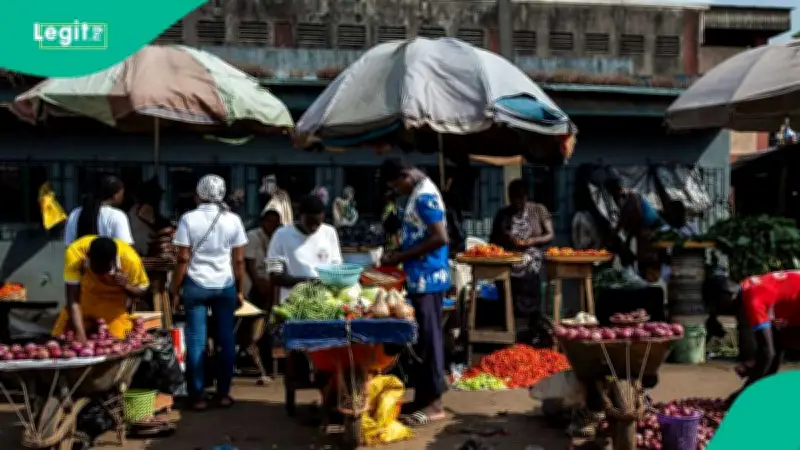
The National Bureau of Statistics (NBS) has reported that Lagos, Imo, and Ondo recorded the highest annual food inflation rates among Nigerian states in September 2026, with Lagos leading at 34.4%, Imo at 33.8%, and Ondo at 31.5%. In contrast, Taraba and Yobe recorded negative annual food inflation rates of -7.5% and -0.4%, respectively, while Borno recorded 2.2%.
National Food Inflation Drops to 19.59%
According to the NBS, Nigeria's food inflation rate stood at 19.59% in September 2026, down from 20.16% recorded in September 2025. On a month-on-month basis, food inflation fell to -1.55% in September, down from 1.02% in August. This indicates that average food prices declined during the month, although price movements varied significantly across states.
The data, released on October 15, 2026, shows significant differences in food price movements across the country, with some states recording annual increases above 30% while others experienced declines.
Top 10 States With Highest Food Inflation
The top 10 states with the highest annual food inflation rates in September 2026 were:
- Lagos: 34.4%
- Imo: 33.8%
- Ondo: 31.5%
- Delta: 30.6%
- Benue: 27.3%
- Rivers: 26.8%
- Ebonyi: 25.7%
- Osun: 25.2%
- Oyo: 24.5%
- Ogun: 24.2%
Delta ranked fourth at 30.6%, while Benue recorded 27.3%. Rivers, Ebonyi, Osun, Oyo, and Ogun completed the top 10 states with the highest annual food inflation rates.
States With Lowest Food Inflation
At the other end of the ranking, Taraba recorded the lowest annual food inflation rate at -7.5%, followed by Yobe at -0.4%. These negative rates indicate that food prices were lower than in the corresponding period a year earlier.
Borno recorded an annual food inflation rate of 2.2%, while Bauchi and Nasarawa both posted 5.3%. The 10 states with the lowest food inflation rates in September 2026 were:
- Taraba: -7.5%
- Yobe: -0.4%
- Borno: 2.2%
- Bauchi: 5.3%
- Nasarawa: 5.3%
- Kebbi: 5.4%
- Sokoto: 6.1%
- Jigawa: 8.1%
- Kogi: 8.6%
- Bayelsa: 9.3%
Rice Prices Fall Across Categories
In a related development, rice prices in Nigeria dropped across all major categories in September 2026, with data showing month-on-month declines for Nigerian manufactured, imported long-grain, and imported short-grain rice across multiple bag sizes and retail measures.
Imported long-grain rice recorded the sharpest fall. Its 50kg average price dropped from N56,093.75 in August to N54,328.13 in September, a reduction of N1,765.62 or 3.1%. Nigerian manufactured rice in the same size fell from N52,250 to N51,571.43, while imported short-grain rice declined from N52,300 to N50,950.
The NBS data underscores the uneven impact of food price movements across Nigeria, with coastal and southern states facing higher inflation while some northern states see price declines.