
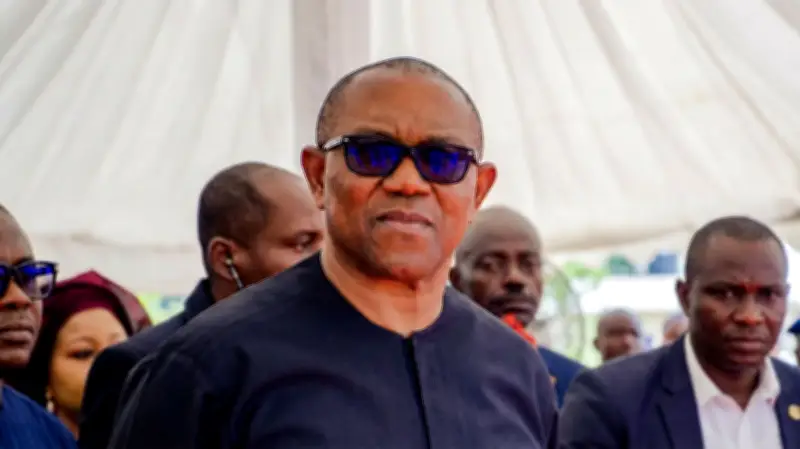
The 2027 presidential candidate of the Nigeria Democratic Congress (NDC), Peter Obi, has challenged President Bola Tinubu’s administration to provide a detailed account of how borrowed funds have been utilised, raising concerns over what he described as unprecedented debt accumulation without corresponding transparency.
Presidency Responds to Debt Claims
But the Presidency dismissed Obi’s claims that the Tinubu administration accumulated more than N100 trillion in debt within three years, attributing the increase in Nigeria’s debt profile largely to the impact of naira devaluation.
Meanwhile, the International Monetary Fund (IMF) warned yesterday of risks surrounding Nigeria’s plan to borrow up to $5 billion through a derivatives agreement with First Abu Dhabi Bank of the United Arab Emirates (UAE), saying such transactions are often opaque and complex.
Obi’s Statement on Debt Growth
Obi, in a statement posted on his X handle yesterday and circulated by the Peter Obi Media Reach (POMR), raised the alarm over Nigeria’s growing debt profile, which he said rose to about N200 trillion under the Tinubu administration.
According to him, the increase represents more than N100 trillion added to the nation’s debt burden within three years, a pace he argued far exceeds the borrowing trend recorded during the administration of former President Muhammadu Buhari.
The former governor of Anambra State said the issue extended beyond the volume of borrowing to a lack of accountability in the deployment of the funds.
Citing figures from the Budget Office, Obi claimed that the Federal Government borrowed N11.89 trillion between January and September 2025, surpassing its approved borrowing target of N10.34 trillion by about N1.54 trillion.
He argued that in a transparent system, exceeding approved borrowing limits should trigger public scrutiny and detailed explanations from government agencies.
Obi further noted that only N3.10 trillion of the borrowed funds was reportedly directed to capital projects during the same period, representing just 17.66 per cent of the N17.58 trillion budgeted for capital expenditure.
Presidential Aide’s Defense
Special Assistant to the President on Social Media, Dada Olusegun, while responding to Obi, stated: “For the umpteenth time, Nigeria’s obvious debt portfolio increase over the past three years under the administration of President Tinubu is not a function of new borrowings; rather, the vast majority of them are mathematical impacts of currency devaluation, which you also promised to implement during your campaigns.”
He argued that a significant portion of the country’s debt profile predated the Tinubu administration, noting that the government inherited about N20 trillion in Ways and Means debt, which was later securitised.
“This administration inherited a whopping Ways and Means debt of around N20 trillion, which was securitised to ensure swift repayment by the nation. This makes up a significant portion of the debts Obi is claiming the administration has accumulated within three years,” he said.
IMF Warning on UAE Swap Deal
The Senate in April 2026 approved the deal with the UAE bank, joining other African borrowers, such as Senegal and Angola, who have tapped similar arrangements over the past year.
“Our view is that the transactions in these types of structures carry risks. Usually, they are opaque, so the terms are not always very transparent when we reviewed these instruments across countries,” IMF Mission Chief in Nigeria, Christian Ebeke, told reporters.
Ebeke said Nigeria could instead issue eurobonds to finance its deficits or other means to raise funding, including on concessional terms.
Nigeria intends to use proceeds from the Total Return Swap (TRS) to refinance expensive debt and pay for infrastructure.
In its latest Article IV review, the Fund praised Nigeria’s sweeping reforms, saying they had strengthened economic stability and investor confidence, but warned that the benefits had yet to reach millions of citizens and could be undermined by global shocks, including the Middle East conflict.
The reforms since 2023 under Tinubu, including the removal of the fuel subsidy, tighter monetary policy, and exchange rate liberalisation, have rebuilt buffers and improved macroeconomic management, the IMF said.




