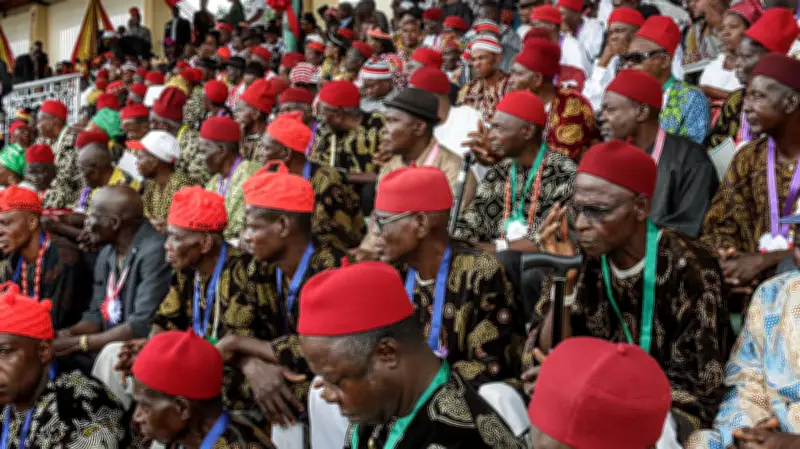
Twin man-made crises are steadily unsettling the Igbo traditional institution in the South-East and the diaspora. These royal crises have added to the many problems afflicting the Igbo nation at home and abroad.
Killings of Traditional Rulers in Igbo Land
On March 1, 2026, gunmen abducted from a church and killed the traditional ruler of Ndufu-Alike in Ikwo Local Council of Ebonyi State, Eze Francis Igwe. His remains were recovered about a week later from where they were dumped and taken to the mortuary. The monarch, who was the father of the immediate past deputy governor of Ebonyi State, Kelechi Igwe, was picked up from an Assemblies of God Church in his area, where he was conducting a Sunday school class for the children. His assassins drove him in his own vehicle (after theirs broke down) to the destination where he was tortured to death. Sources said that before his death, the late monarch was not in the habit of moving around with a retinue of security aides, hence they suspected that some members of the community had a hand in his death.
Igwe's death was shortly followed by that of the Traditional Ruler of Ishinkwo Community in Onicha Local Council of Ebonyi State, His Highness, Jehoshaphat Ikegwu, who was killed by his killers who invaded his palace in the night and shot through his window at about 10 pm when the traditional ruler had retired to bed. His death, which happened right in front of his wife, left the community in shock and mourning.
On April 11, 2026, assassins took down the Traditional Ruler of Ochie Autonomous Community in Ohaji/Egbema Local Council of Imo State, Eze Paulinus Ekwueme. The monarch, according to multiple sources, was on an errand in the council area with five other members of his community when killers swooped on them. They thereafter set his body on fire and fled.
The rash of killings of monarchs in Igbo land is simply adding a fresh layer of worry to the existential challenges plaguing the region. While in the past, monarchs were revered and looked at as authorities in the sphere of culture and tradition, issues concerning them were treated with dignity, and taking their lives for whatever reason was sacrilegious. All these appear to have changed, with three of them murdered in the last six months. To date, the motives of their murder remain unknown, the same as those behind the killings.
Aside from monarchs who were kidnapped but regained freedom after payment of ransom, as well as those that escaped from their captors, investigation by The Guardian showed that between 2022 and 2025, at least eight traditional rulers have been killed in the South-East. For instance, in Enugu State in 2024, His Highness Igwe Patrick Ezeugwu of Adani Community in Uzo Uwani Local Council was murdered in his palace. In 2023, in Ebonyi State, Ezeogo Christopher Igboke of Umuezeokoha in Ezza Local Council was killed in his palace. In 2024, His Highness Eze Omaze Ibo Ubani, the traditional ruler of Umuihe Community, Akaeze Ivo Local Council, was murdered by gunmen in his palace. Also, in Abia State, in 2022, Eze Ignatius Asor was killed by gunmen in his palace, while in 2023, Eze Micheal Okechukwu was found dead after being abducted from his home. In Imo State, His Highness Eze Ignatius Asor of Obudi Agwa in Oguta Local Council was killed in his palace in 2022. The attack claimed the lives of two of his aides. In 2023, the traditional ruler of Orsu Obodo Community in Oguta Local Council, His Highness Eze Victor Ijioma, was assassinated at Umuamaka Junction, in Izombe town, and his body was set ablaze inside his car. Within the same period, the traditional ruler of Nguru Community in Aboh Mbaise Local Council, Eze James Nnamdi (Eze Mmirioma), was shot and killed in his palace.
Controversy Over Eze Ndigbo Titles Abroad
To culture and tradition watchers, it is not only the killing of monarchs in Igbo land that is of great concern to them. The chaos that has accompanied the emergence of Eze Igbo (King of Igbo) title holders, both within and outside the country, is also casting the region in a troubled light, especially given that it pits them, in most cases, against traditional institutions in their host states or countries.
Most recent is the March 14, 2026, kingship enthronement incident in the Eastern Cape, South Africa, that led to violent protests in that country. It all started after an Igbo businessman, Solomon Eziko, took the title of “Eze Ndigbo na East London (Igbo King in East London), South Africa.” After being crowned as a traditional ruler in KuGompo City (East London), South Africans interpreted the move as an unlawful challenge to local sovereignty and traditional rulership structure. This elicited protests, which developed into violence after some days, with Igbo people living in the area and their businesses as targets. The leaders of the area condemned the coronation as a “flagrant violation” of customary protocols.
Last year, another Igbo businessman, Chukwudi Ihenetu, allegedly caused problems in Ghana over an Eze Ndigbo of Ghana traditional title that was bestowed on him. The violence that followed the development led to the “Igbo must go” protest in Ghana, but he defended his position, maintaining that the role was ceremonial and meant solely to unify the Igbo community in Ghana.
Reactions from Igbo Groups
One organisation that is peeved with the entire shenanigan that is going on, especially the killing of monarchs, is the Ohannivo Youth Forum, Ebonyi State, which described the development as “growing evil.” A statement signed by its national president and secretary, George Nwoye and Collins Odili respectively, noted that the deaths of these paramount rulers were “without justifiable causes.” They recalled with sadness the disappearance of former paramount ruler of Isuokema Autonomous Community in the same Onicha Local Council, Ezeogo Ambrose Okorie Ogbu, and the murder of His Highness Eze Omaze Ibo Ubani of Akaeze in Ivo Local Council.
Another Igbo youth platform, Youth Renaissance, condemned the killing of traditional rulers, describing it as “a bad omen.” They said in a statement, signed by their leader, Chukwuma Okenna, that “Igbo must rise above denigrating their own,” even as they blamed the development on the increasing rate of drug abuse.
Government and Ohanaeze Intervention
The rash of kingship enthronement outside the shores of the region and the problems it is now creating between the Igbo and their host communities formed the crux of discussion when the Minister of Foreign Affairs, Bianca Odumegwu-Ojukwu, addressed the Imeobi/General Assembly of Ohanaeze Ndigbo recently. Odumegwu-Ojukwu lamented the embarrassment that such situations were causing the Igbo people and Nigeria, noting that people could express themselves culturally without constituting a nuisance to the indigenous people of host countries and others. She recalled that the young man in Ghana was flamboyant and decided to carve out a street for himself to actualise his becoming an Eze Igbo, stressing that no lessons were learnt from the destruction that followed the incident by other Igbo in other places. Odumegwu-Ojukwu enumerated stringent efforts by the Federal Government to quell what could have caused human lives and businesses of Igbo and other Nigerians in Ghana and South Africa, stressing there was a need for Ohanaeze Ndigbo to take a stand on the matter.
“It is becoming embarrassing even for the government. We threaten others with our wealth; we don’t have regard for the custodians of our cultures and traditions in our communities, once there is money in our pockets. The ugly thing about this attitude is that the moment we make kings outside, we don’t have regard for the traditional rulers in our communities any longer. It is threatening lives; it is threatening the businesses of Igbo people in those areas. Unless we take action against this, many lives may be lost in the future,” she stated.
The Chairman, South-East Traditional Rulers Council, His Highness, Emma Okeke, while lamenting the development, stated that traditional rulers had in the past written to states asking Igbo people residing there to refrain from the act and to be tolerant in their dealings. “The letters worked then. But we have also discovered, of late, that there are people bent on creating problems because of their wealth. This idea of placing value on wealth is the cause of it all. We can still write again through the governors and the leaders of Ohanaeze Ndigbo in the various states,” he suggested.
However, the Ohanaeze Ndigbo and the South-East Council of Traditional Rulers resolved to end the practice. They stated that such practice would no longer be recognised by the Igbo leadership and would sanction any individual who confers the Eze Igbo title on himself outside the region. “The National Executive Council (NEC) of Ohanaeze Ndigbo, after an extensive meeting with the Council of Traditional Rulers of the South-East, declares the award of the title of Eze Ndigbo outside Igboland invalid. Anybody who is being awarded that type of title anywhere outside of Igbo land is on his own,” he said. He added that sanctions for defaulters would be determined in consultation with traditional rulers and enforced at the grassroots level through communities and town unions.
Mixed Reactions and Way Forward
The way it is, the renewed killings of paramount rulers and the crisis associated with the title of Eze Igbo outside the shores of Igbo land, no doubt, are twin issues currently unsettling the region. Will the ban on the title of Eze Igbo by Ohanaeze Ndigbo, with its attendant implications, be obeyed? A lawyer, Dr Vitus Ozoke, faulted Ohanaeze Ndigbo’s stance. He stressed that Igbo in the Diaspora, whether in Lagos, Abuja, and Kano or across continents, “has historically relied on structures such as the Eze Igbo institution for cohesion, representation, and cultural continuity.” He stated that the titles are not mere ornaments but functional mechanisms for community organisation in environments where traditional structures do not naturally exist, stressing that to undermine them is to weaken the very fabric that sustains Igbo identity outside its geographic origin.
Although he did not rule out community differences as often responsible for attacks on paramount rulers, Bethel Ugiri, a community leader from Asa-Ihechiowa in Imo State, stated that state governments should find a way to improve security in communities. Ugiri emphasised that most communities exist without the presence of security officials, stressing that such development makes the dwellers vulnerable to attacks. He, however, decried attacks on paramount rulers, saying it shows how “values have been degraded in the region,” even as he cautioned monarchs to focus on their core responsibilities.