
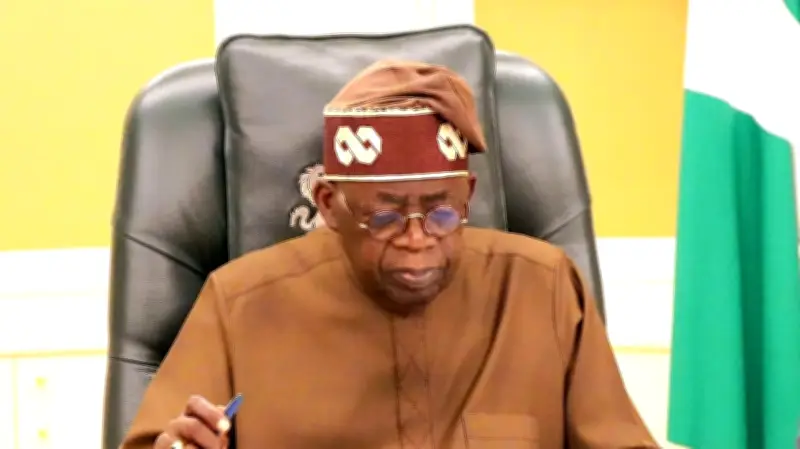
President Bola Tinubu has called for greater tax compliance from Nigerians, emphasizing that sustainable infrastructure development depends on citizens' willingness to contribute their fair share to the nation's revenue pool. However, Peter Obi, presidential candidate of the Nigeria Democratic Congress (NDC), questioned the contradiction between the Federal Government's reported surge in revenue and the worsening economic conditions facing millions of Nigerians, demanding greater transparency over the management of public finances.
Meanwhile, business confidence improved across Nigeria in May 2026, as firms reported positive assessments of their operations and the broader economy, even as inflationary pressures continued to weigh on households and businesses, according to the latest surveys by the Central Bank of Nigeria (CBN).
Tinubu's Call for Tax Compliance
Tinubu made the appeal while commissioning the full-scope development of Arterial Road N5 (Obafemi Awolowo Way), stretching from Life Camp Junction to Ring Road III in the Dape District of the Federal Capital Territory (FCT). Represented by Vice President Kashim Shettima at the event, Tinubu said the newly completed road was a strategic investment designed to improve connectivity, reduce traffic congestion, and unlock economic opportunities within the rapidly expanding capital city.
According to the President, infrastructure development remains central to the Renewed Hope Agenda, adding that the government requires adequate and sustainable revenue to continue funding roads, bridges, schools, hospitals, and other public facilities across the country. "Projects such as this remind us that development is a shared responsibility. Every kilometre of road, every bridge, and every public facility is made possible through collective contributions to the national purse," he said.
Tinubu urged individuals and businesses to embrace tax payment as a civic obligation, noting that improved compliance would strengthen the government's capacity to meet growing infrastructure demands without excessive dependence on borrowing. He said the administration was committed to ensuring transparency and accountability in the use of public resources, assuring taxpayers that revenues generated would continue to be channelled into projects that directly benefit citizens.
Peter Obi Questions Revenue Claims
Reacting to Tinubu's recent assessment of his administration's three years in office, Obi argued that the government's claims of significantly improved revenue generation have not translated into tangible improvements in the lives of citizens. The former governor of Anambra State noted that Tinubu had highlighted an increase in government revenue from N16.8 trillion in 2022 to N35 trillion in 2025, representing more than a 100 per cent increase within three years.
According to Obi, such a dramatic rise in revenue should ordinarily have reduced the government's dependence on borrowing. Instead, he said, Nigeria's debt profile has expanded at an alarming rate. "While Nigerians expected a reduction in borrowing with the exponential increase in revenue, the opposite appears to be the case," Obi stated. "In just three years, the nation's total debt has risen to about N200 trillion, representing an increase of over N100 trillion."
The presidential candidate further argued that beyond the officially reported revenue growth, Nigeria had also benefited from favourable global and regional economic developments that boosted earnings above budget projections. He pointed to a fall in Nigeria's Gross Domestic Product (GDP) per capita, which he said dropped from $1,597 in 2023 to $1,223 in 2025, reflecting the growing strain on citizens despite the government's claims of economic reforms and fiscal gains. The NDC flagbearer maintained that prudent management of resources, investment in productive sectors, and policies focused on lifting citizens out of poverty remain critical to reversing the country's economic fortunes.
CBN Surveys Show Mixed Economic Picture
The CBN's Statistics Department, in separate releases of its Business Expectations Survey (BES) and Inflation Expectations Survey (IES), painted a mixed picture of the economy, with improving business sentiment tempered by persistent concerns over rising prices, high borrowing costs, and structural challenges. The Business Confidence Index (BCI) rose to 7.9 points in May, reflecting growing optimism among businesses. Respondents projected stronger confidence in the months ahead, with the index expected to rise to 16.9 points next month, 24.9 points over the next three months, and 31.9 points within six months.
The survey, which covered 1,900 enterprises between May 11 and 15, attributed the improvement largely to easing governance and policy concerns, which accounted for 15.7 per cent of positive sentiment, as well as progress in economic diversification efforts at 15.6 per cent. However, businesses continued to identify energy-related challenges and geopolitical uncertainties as major concerns, accounting for 26.7 per cent and 7.7 per cent of negative sentiment drivers, respectively.
Sectoral performance was positive across the board. Confidence in the industrial sector rose to 12.5 points from 8.8 points in April, while agriculture increased to 9.4 points from 2.7 points. The services sector also improved, rising to 4.6 points from 1.5 points. Mining and quarrying recorded the highest confidence on own operations at 63.6 points, followed by Non-market Services at 38.5 points, manufacturing at 34.8 points, agriculture at 31.2 points, construction at 29.1 points, and market services at 28.7 points.
Meanwhile, the apex bank's inflation expectations survey showed that inflationary pressures remained a major concern for both households and businesses. The Inflation Perception Index (IPI) rose to 44.8 points in May, while the proportion of respondents who considered inflation to be high increased to 70.5 per cent from 67.2 per cent in April. Among households, the share rose to 72.8 per cent from 68.8 per cent, while business respondents reporting high inflation increased to 68.4 per cent from 65.9 per cent.




