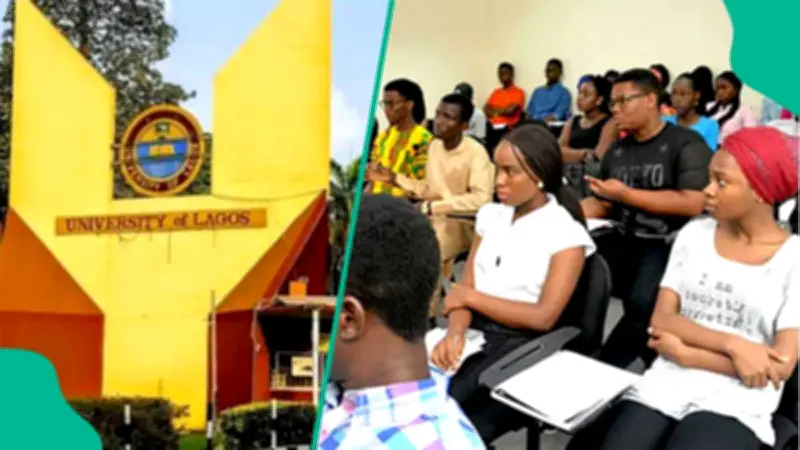
The Femi Gbajabiamila Hall of Residence at the University of Lagos (UNILAG), constructed with N1.6 billion in federal government funds to ease the institution's accommodation crisis, now charges students up to N950,000 per bed space for an academic session, according to investigations by BusinessDay.
The 484-bed facility, which was commissioned on January 3, 2024, was initiated through a Zonal Intervention Project approved in 2020. It was named after Femi Gbajabiamila, the then Speaker of the House of Representatives who later became Chief of Staff to President Bola Tinubu.
How a N1.6bn Federal Project Came to UNILAG
The project's origin dates back to 2019, when the then Vice-Chancellor of UNILAG, Professor Oluwatoyin Ogundipe, sought the intervention of Gbajabiamila, an alumnus of the university. The university management wanted assistance in tackling its persistent accommodation infrastructure deficit, which had placed academic, financial, and welfare pressures on students.
The intervention resulted in the approval of the “Construction and Furnishing of a 484-bed Landmark Student Hostel at the University of Lagos” under the Zonal Intervention Project Appropriation Act of 2020. The federal government allocated N1.6 billion for the construction. The hostel was subsequently named after Gbajabiamila, with his sculpture positioned at the entrance.
The facility was officially commissioned by the then Speaker of the House of Representatives, Tajudeen Abbas, who represented Gbajabiamila, who had by then become Chief of Staff to President Bola Tinubu.
From Government Intervention to Premium Accommodation
Instead of serving as a low-cost option for students struggling to secure decent housing, the facility now operates with fees that put it beyond the reach of many students. BusinessDay investigations found that students occupying a single room pay N950,000 per academic session, while each student in a four-man en-suite room pays N710,000.
This means that a four-man room generates N2.84 million when all four occupants pay the stated annual fee. The pricing places the hostel in the premium end of student accommodation at UNILAG, despite its origin as a federally funded intervention.
The facility offers two main accommodation categories: single-occupancy rooms and four-man en-suite rooms. With 484 bed spaces and fees ranging from N710,000 to N950,000 per occupant, the hostel could generate roughly N300 million in annual accommodation revenue if fully occupied, according to BusinessDay calculations.
Public Money, Continued Public Spending
The N1.6 billion construction allocation was not the only government funding associated with the facility. Successive federal budgets have also provided funds for maintenance and improvement. In the 2024 budget, N247,963,258.79 and a further N250 million were allocated for the “provision of additional facilities and maintenance of Femi Gbajabiamila Hall of Residence, University of Lagos.”
This ongoing public spending, combined with the premium pricing, raises questions about the hostel's accessibility to the students it was designed to serve. The facility's revenue potential of approximately N300 million annually further highlights the tension between its public purpose and commercial operation.
As of the time of this report, UNILAG had not issued an official response to the pricing concerns raised by BusinessDay. The debate continues over whether a publicly funded student welfare project should operate like a commercial hostel, and what measures might be taken to ensure the facility serves its intended population.