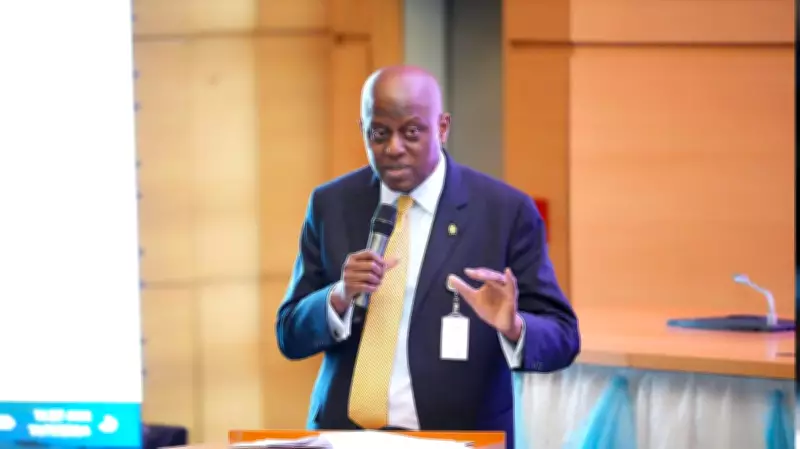
Dele Oye, Chairman of the Alliance for Economic Research and Ethics LTD/GTE, has declared that Nigeria's credit deficit, exceeding N130 trillion, is severely hampering the growth of approximately 39 million micro, small, and medium enterprises (MSMEs). He warned that the nation's financial system has failed to adequately support productive businesses.
In a statement, Oye characterized the widening disparity between the financing needs of small businesses and the capacity of financial institutions as a "structural failure" in capital allocation. This failure, he argued, has become a major barrier to job creation, productivity, and sustained economic growth.
Oye highlighted that although MSMEs constitute the majority of businesses and a significant portion of employment in Nigeria, access to formal credit remains extremely limited. This forces many entrepreneurs to rely on informal funding sources or expensive short-term loans, which restrict business expansion.
"Nigeria operates a network of Development Finance Institutions (DFIs) whose combined total asset base is slightly above N8 trillion, against a development finance requirement for MSMEs alone estimated at over N130 trillion. This is not a funding gap; it is a funding abyss," he stated.
He further emphasized the severity of the situation: "Let us begin with a number that should shame every policymaker, every bank board, and every development finance executive in Nigeria: fewer than one in twenty MSMEs in Africa’s largest economy have access to formal bank credit. In a nation where MSMEs account for 96 percent of all businesses, 48 percent of GDP, and 84 percent of private sector employment, this is not a market imperfection; it is a structural catastrophe."
Oye acknowledged the World Bank's approval of the $500 million Fostering Inclusive Finance for MSMEs in Nigeria (FINCLUDE) programme in December 2025 as a welcome intervention. The initiative is expected to mobilize $1.89 billion in private capital and provide debt financing to 250,000 enterprises, including 150,000 women-led businesses and 100,000 agribusinesses. However, he argued that the intervention also exposes deeper weaknesses within Nigeria's financial system.
"When an economy the size of Nigeria's requires a multilateral institution to guarantee $800 million in credit to mobilize domestic capital for its own small businesses, the problem is not risk. The problem is vision, governance, and the systematic misalignment of financial incentives," he said.
Oye pointed out that the macroeconomic environment has encouraged commercial banks to avoid lending to small businesses. "With the CBN's Monetary Policy Rate standing at 26.50 percent as of February 2026, following a modest 50-basis-point reduction from the peak of 27.50 percent and headline inflation at 15.69 percent as of April 2026, the real cost of capital remains punishing."
He noted that the Standing Deposit Facility, through which banks keep excess liquidity with the Central Bank of Nigeria overnight, creates an incentive structure that favors risk-free returns over productive lending.
Nigeria's domestic credit to the private sector stands at about 17.6 percent of GDP, placing the country among the world's most financially underdeveloped economies. Oye compared this to South Africa's ratio of over 70 percent and Kenya's above 30 percent, adding that even the Sub-Saharan African average excluding South Africa and Nigeria is higher than Nigeria's level. "For an economy that aspires to be in the top twenty globally by 2050, this is not a gap; it is a chasm," he said.
The economist called on commercial banks to strengthen their SME lending systems by investing in underwriting capacity, hiring sector specialists, and deploying technology-driven risk management tools. He also urged businesses to improve their financial records and formalize operations to enhance credit access. "The enterprise sector must meet the system halfway. Open verifiable bank accounts, file taxes, maintain audited records, and register assets. Build banking relationships before credit is needed," he advised.
Oye stressed that while the World Bank-backed FINCLUDE programme will support thousands of businesses, the scale of Nigeria's MSME financing challenge requires broader domestic reforms. "The World Bank's FINCLUDE programme will mobilize $1.89 billion and extend credit to 250,000 MSMEs. That is meaningful progress. But Nigeria has over 39 million MSMEs. The mathematics of external intervention, however generously structured, cannot close a gap of that magnitude," he stated.
He called for reforms across key government institutions, including the Federal Government, the Central Bank of Nigeria, the Bank of Industry, the Bank of Agriculture, and the Nigerian Export-Import Bank, alongside stronger participation from commercial banks and enterprises.
Referring to President Bola Tinubu's Renewed Hope Agenda, Oye said the challenge now is whether the government and relevant institutions will undertake the "technically demanding work of credit market reform." He concluded, "Nigeria's 39 million MSMEs are not waiting for another speech. They are waiting for a loan."