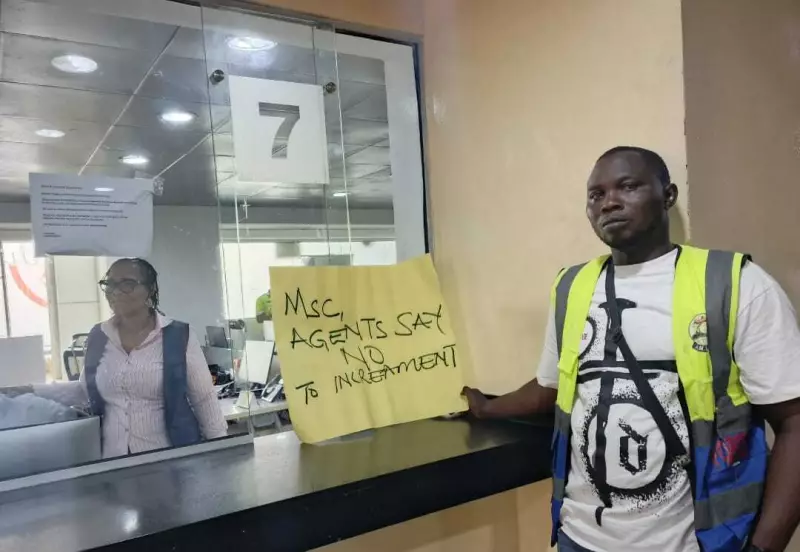
Freight forwarders operating at the Lagos ports have brought activities to a standstill at the Apapa office of the Mediterranean Shipping Company (MSC). The dramatic shutdown is a direct protest against a recent increase in charges imposed by the shipping line.
Port Operations Grind to a Halt
The protest action was led by aggrieved members of the Association of Nigeria Licensed Customs Agents (ANLCA), Western Zone. Scores of agents converged on the MSC office in Apapa, effectively stopping operations from about 1:35 pm on Tuesday, January 12, 2026.
They have demanded a complete closure of the shipping company's activities from 6 am daily until MSC reverts to its previous tariff structure. The agents argue that the planned increments are difficult to justify, coming barely three years after shipping lines raised tariffs by over 400 per cent.
Femi Anifowose, the Western Zone Coordinator of ANLCA, emphasized that the relative stabilisation of key cost drivers like foreign exchange rates and diesel prices makes the latest hike unreasonable. He warned that the cumulative burden of port charges is pushing up import costs, a consequence that will ultimately be passed on to Nigerian consumers.
Broader Industry Grievances Surface
Anifowose accused shipping companies in Apapa of failing to demonstrate social responsibility to their host communities, despite generating substantial revenue from Nigeria's trade. He stated that unchecked shipping charges and persistent operational inefficiencies are undermining trade and worsening inflation in Nigeria's import-dependent economy.
The protest gained wide support, with other major freight forwarding associations joining the action. These included the National Association of Government Approved Freight Forwarders (NAGAFF) and the African Association of Professional Freight Forwarders and Logistics of Nigeria (APFFLON).
Dr. Emeka Paul Chiedozie, the NAGAFF Tin Can Chapter Chairman, strongly rejected MSC's increase. He also criticized the company's container refund policy as the worst in Nigeria. Chiedozie highlighted the unfair burden on agents who must physically visit MSC offices to process refunds, only to wait months for payment.
He pointed to the containers littering port access roads, alleging that over 75 per cent belong to MSC. Chiedozie declared that NAGAFF members at Tin Can Island Port would not accept the increment and would escalate the matter formally to the Nigerian Shippers’ Council (NSC), the port's economic regulator.
Shipping Company Cites Approved Costs
In response, Mr. Jesse Chege, MSC's Africa Regional Controller for Finance and Administration, provided a different perspective. He stated that the need for an increment was due to the increased cost of doing business in Nigeria.
Chege noted that the increment had been deliberated over a two-year period with the Nigerian Shippers’ Council, which had officially approved the new charges in December 2025.
The standoff highlights the ongoing tension between service providers and operators at Nigerian ports, with the latest protest threatening to disrupt the flow of cargo until a resolution is found.