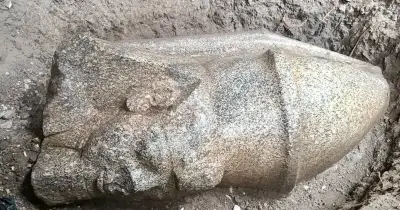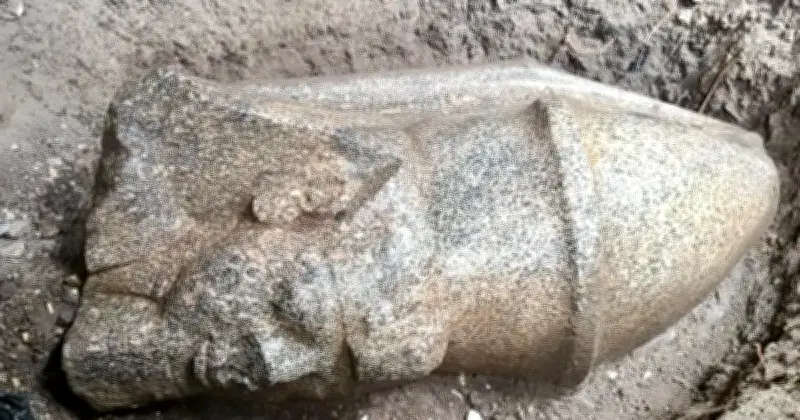
An Egyptian farmer’s chance discovery of an inscribed stone while working his land has led archaeologists to uncover the head of a colossal statue of Pharaoh Ramesses II, estimated to have originally stood about 28 feet tall. The find, made in the Nile Delta village of Behbeit El Hagar, also yielded a second royal statue and a granite block bearing hieroglyphic inscriptions.
How the Discovery Unfolded
Khaled al-Shahat found the unusual inscribed stone while working on land outside his home in Behbeit El Hagar, a village in Egypt’s Gharbia Governorate. According to CBS News, al-Shahat reported the stone to the relevant authorities, prompting Egypt’s Supreme Council of Antiquities to launch excavations at the site.
The excavation uncovered the head of a colossal statue depicting King Ramesses II, one of ancient Egypt’s most famous rulers. The head measures approximately 1.6 metres (5.25 feet) tall and shows the king wearing the double crown symbolising his rule over Upper and Lower Egypt.
Statue Size and Additional Finds
Based on the size of the head, archaeologists estimate that the complete statue, including its base, would have stood approximately 8.5 metres (28 feet) tall. Researchers also recovered part of the statue’s back pillar, which carries the king’s Horus name, “Hor Ka Nakht Mery Maat”.
The excavation revealed the remains of a second royal statue measuring approximately 2.4 metres (7.9 feet) in its surviving section. Although its legs and base are missing, its head retains clearly visible facial features. Archaeologists believe the second statue may also depict Ramesses II because its facial features resemble those of the first statue.
Hieroglyphic Block and Historical Context
A nearby pink granite block measuring approximately 1.3 metres (4.3 feet) long was also found bearing hieroglyphic inscriptions containing royal titles associated with Ramesses II, including “King of Upper and Lower Egypt” and “Son of Ra”, a reference to the ancient Egyptian sun god.
Ramesses II ruled Egypt from approximately 1279 BC to 1213 BC and is often associated with the unnamed pharaoh in the biblical account of the Exodus, in which Moses confronts Pharaoh over the Israelites’ enslavement. However, the Bible does not explicitly identify the pharaoh by name, and the suggestion that Ramesses II was the ruler in the story remains debated. The newly discovered statues do not establish a connection between the ancient king and the biblical account.
Significance and Recognition
The discovery was made near the remains of a large temple dedicated to the goddess Isis, making the excavation potentially significant to researchers studying the area’s ancient history and religious importance. Egypt’s Minister of Tourism and Antiquities, Sherif Fathy, praised al-Shahat for reporting the find instead of keeping the stone. CBS News reported that the farmer and his wife received certificates of appreciation and a trip to Saudi Arabia to perform Umrah.
Archaeologists are continuing excavations and studies to determine how the statues relate to the surrounding site and what they can reveal about the region’s history and architectural development.