
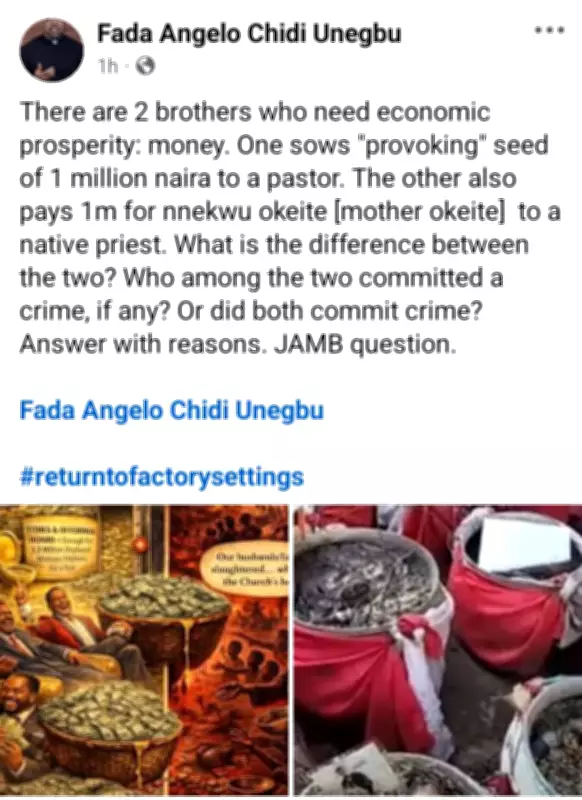
Nigerian Catholic Priest Sparks Debate on Tithing Versus Oke-Ite Money Ritual
A Nigerian Catholic priest, Fr. Angelo Chidi Unegbu, has ignited a significant public discussion by questioning the fundamental difference between church tithing and the controversial money ritual practice known as Oke-Ite. This inquiry comes in the wake of recent government crackdowns targeting native doctors and individuals allegedly involved in the Oke-Ite phenomenon across various regions.
Provocative Question Posed to Followers
Fr. Unegbu presented a thought-provoking scenario to his social media followers, framing it as a critical examination of economic prosperity-seeking behaviors within Nigerian society. He described a hypothetical situation involving two brothers, both in urgent need of financial breakthrough.
The priest wrote: "There are two brothers who need economic prosperity: money. One sows a 'provoking' seed of 1 million naira to a pastor. The other also pays 1 million naira for nnekwu okeite [mother okeite] to a native priest. What is the difference between the two? Who among the two committed a crime, if any? Or did both commit crime? Answer with reasons. JAMB question."
Context of Recent Crackdowns on Oke-Ite Practices
The priest's query directly responds to heightened law enforcement activities against practitioners of Oke-Ite, a money ritual that has gained notoriety in Nigeria for its alleged supernatural promises of wealth through spiritual means. Authorities have recently intensified operations to apprehend native doctors and individuals suspected of participating in or promoting these rituals, citing concerns about fraud, exploitation, and potential links to criminal activities.
This comparison challenges conventional religious and societal norms by juxtaposing a widely accepted Christian practice—tithing, where believers donate a portion of their income to the church—with a culturally contentious spiritual practice that many view as illicit or morally questionable.
Broader Implications for Religious and Economic Practices
Fr. Unegbu's question raises profound ethical and theological considerations about the nature of financial transactions within spiritual contexts. It prompts reflection on several key issues:
- The perceived legitimacy of different spiritual approaches to economic gain
- The moral boundaries between accepted religious donations and controversial ritual payments
- The societal and legal definitions of what constitutes a criminal act in spiritual-economic exchanges
- The psychological and social pressures driving individuals toward both tithing and money rituals in pursuit of prosperity
The reference to "JAMB question"—alluding to the rigorous Nigerian university entrance examination—suggests the priest intends this as a serious intellectual and moral challenge requiring careful reasoning, rather than a casual inquiry.
Public Reaction and Continuing Dialogue
This provocative comparison has generated widespread discussion among Nigerians, with responses varying across religious, cultural, and legal perspectives. Some commentators support the priest's call for critical examination of all prosperity-seeking spiritual practices, while others defend tithing as biblically mandated and fundamentally distinct from ritual practices like Oke-Ite.
The debate continues to evolve as more Nigerians engage with the underlying questions about faith, finance, and morality in contemporary society.