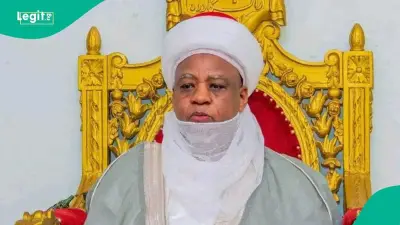
Islamic cleric Sani Jingir has declared that he has no regrets over his recent comments advocating a Muslim-Muslim ticket in Nigeria, standing firmly by his statement and refusing to apologise.
Jingir Stands by His Statement
Speaking in an interview with BBC Hausa on Tuesday, Jingir said he was unmoved by the backlash his remarks generated. "I have absolutely no regrets. I stand firmly by my words and will never apologise. I will continue to advocate for a Muslim-Muslim ticket," he said.
The cleric had earlier addressed a mass wedding organised by the Kano state government for 1,500 couples, where he urged Muslims to "vote in a manner that would reflect their numerical strength in the country." He argued that Nigeria is majorly a Muslim country and that in the 2023 election, Muslims proved their majority by massively voting for the Muslim-Muslim ticket.
Advocacy Based on Religious Beliefs
Jingir clarified that his advocacy was rooted in his religious beliefs and was not an endorsement of President Bola Tinubu or former President Muhammadu Buhari. "I am not campaigning for Bola Tinubu, I am campaigning for my religion. As I have stated before, my advocacy for a Muslim-Muslim leadership structure is not about Tinubu or Muhammadu Buhari. It is strictly for the sake of Allah," he explained.
He described the preaching podium as a sacred space for educating people and said he had a responsibility to communicate what he considered the truth to his congregation. "My additional perspective is that today's world is filled with propaganda, which fails to let people truly understand the situation they are in. The preaching podium is a sacred space meant for education," he added.
Political Participation as Religious Duty
Jingir said he consistently tells his congregation that participating in politics is a religious obligation. He urged Muslims to engage in the process based on their beliefs rather than financial inducements from politicians.
The cleric acknowledged that he had anticipated criticism over his position and would not be discouraged by public backlash. "If you know you are speaking the truth, you must never allow public criticism to discourage you, which is why I continuously emphasise this message. I have already mentally prepared for the backlash. Whatever they say about me, I am fully ready to face it," he stated.
Support from Muslim Community
Jingir also defended his right to advocate for a Muslim candidate, saying his comments did not prevent anyone from voting according to their preference. "My words carry no harm. I explicitly stated that people are free to vote for whoever they want, while I will personally do what aligns with my beliefs," he said.
He claimed to have received widespread support from Muslims over his position. "I swear that I have received immense support from the Muslim community. A vast majority of Muslims agree with this stance. Look at what happened during my address in Kano. I asked the crowd if they stood with Islamic principles, and they overwhelmingly responded in the affirmative," he said.
The cleric's remarks have sparked mixed reactions, but he remains resolute in his advocacy, insisting that his stance is based on religious conviction rather than political allegiance.