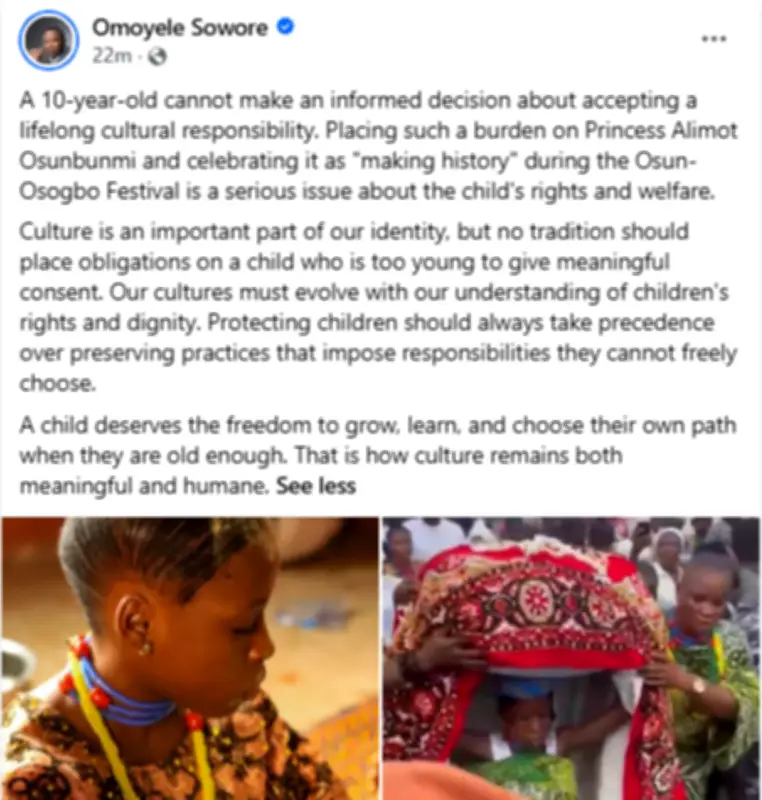
Human rights activist and former presidential candidate Omoyele Sowore has strongly condemned the selection of a 10-year-old princess, Alimot Osunbunmi, to serve as the Arugba (calabash carrier) at the 2025 Osun-Osogbo Festival, held on August 7. In a statement, Sowore described the decision as "child abuse," arguing that a minor cannot give informed consent to undertake such a demanding lifelong cultural responsibility.
Festival Organizers Celebrate 'History in the Making'
Princess Alimot led the historic annual procession to the Osun Sacred Grove in Osogbo, Osun State capital, bearing the sacred calabash containing sacrificial offerings. Festival organizers hailed her role as "history in the making," noting she is the youngest individual ever to fulfill the Arugba position. However, the milestone has ignited intense public debate over child rights and cultural practices.
Sowore's Strong Words on Child Rights
Sowore, known for his advocacy on social justice issues, released a statement saying: "A 10-year-old cannot make an informed decision about accepting a lifelong cultural responsibility. Placing such a burden on Princess Alimot Osunbunmi and celebrating it as 'making history' during the Osun-Osogbo Festival is a serious issue about the child's rights and welfare."
He emphasized that while culture is vital to identity, no tradition should impose obligations on children too young to consent. "Our cultures must evolve with our understanding of children's rights and dignity. Protecting children should always take precedence over preserving practices that impose responsibilities they cannot freely choose," Sowore added.
Background on the Arugba Selection
The young princess was chosen for the revered position in March 2025 through traditional Ifa divination. She succeeds Osuntomi Ewatomi, who retired after a 12-year tenure following her marriage. The Arugba is a central figure in the Osun-Osogbo Festival, which attracts thousands of devotees and tourists annually to the UNESCO-listed Osun Sacred Grove.
Broader Debate on Cultural vs. Child Rights
The controversy highlights a growing tension between preserving cultural traditions and upholding child rights in Nigeria. Child protection advocates have previously raised concerns about practices like this, urging cultural institutions to adopt age-appropriate roles. Sowore's criticism adds to calls for reforms, insisting that "a child deserves the freedom to grow, learn, and choose their own path when they are old enough."
As the festival concludes, the debate is likely to continue, with stakeholders weighing the importance of cultural heritage against the welfare of minors. For now, Princess Alimot's participation stands as a historic yet contentious moment in the festival's long history.