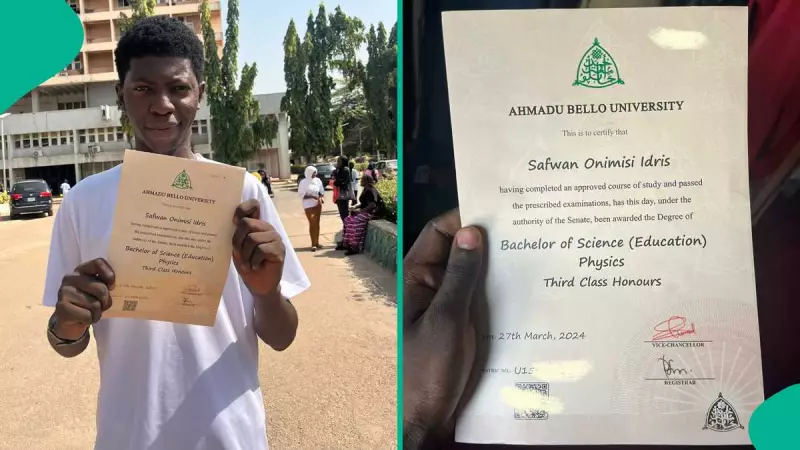
A young Nigerian man who graduated from Ahmadu Bello University in Zaria with a third-class degree has proudly displayed his original degree certificate on social media, reigniting conversations about academic achievement and personal confidence.
From Statement of Result to Original Certificate
Safwan Onimisi Idris, now working as a creative designer, received his Bachelor of Science (Education) in physics from the prestigious Zaria-based institution. The graduate first gained viral attention two years ago when he shared his statement of result on X (formerly Twitter), openly declaring his third-class classification without shame or hesitation.
This recent development marks a significant milestone as Idris finally obtained his official degree certificate, dated March 27, 2024, and immediately shared photographs of both himself and the document with his online followers.
Social Media Post Goes Viral
In his celebratory post on X, Idris wrote: "Today, I receive my original BSc(Ed) Certificate from Ahmadu Bello University, Zaria. Third Class Graduate." The simple yet powerful declaration quickly captured public attention, amassing an impressive 1.5 million views, 13,000 likes, over 1,000 retweets, and approximately 700 comments within a short period.
Mixed Reactions from Internet Users
The display of his third-class degree certificate generated polarized responses across social media platforms, reflecting broader societal debates about educational achievement and success metrics.
Supportive Voices
Many users praised Idris for his confidence and authenticity. One commenter, @IamKennedyJr, remarked: "Omo guy even if na 10th class you get pls be proud of yourself. To go school graduate nodey easy at all. I’m proud of you boss." Another user, @employlawone, offered encouragement based on personal experience: "Congratulations! The future remains bright for you, as it was for me in 1989! See where God has brought me today."
Several supporters questioned the traditional emphasis on academic classifications, with @Bigsomto noting: "If you like .....let people who paid huge sums of money tell you who you are or where you belong because it's they wrote it on a piece of paper.....the world is changing your first class no longer adds value to you..just a first choice for corporate slavery."
Critical Perspectives
Other social media users expressed skepticism or criticism regarding the celebration of a third-class degree. @getKennethed22 commented: "I do not intend to laugh. But I am laughing hysterically. Guy you go plY for school. Study education still came out celebrating 3rd class." Meanwhile, @PamEphraim questioned the terminology used: "Why did they write third class 'honours' what is honorable about it?"
Some comments highlighted perceived regional disparities in employment opportunities, with @TerryObok observing: "Funny this wont ever determine the outcome of a northerner in the federal government parastatal. He will go on to be group managing director of NNPC. Yet we from the south will be blocking doors for others telling them to get 2:1. Getting it is good if you can but not a recipe for success."
Broader Implications and Previous Recognition
This incident continues a narrative that began two years ago when Idris first shared his academic results online. His initial post not only went viral but also attracted tangible rewards, including a cash gift from an anonymous crypto trader who was inspired by the graduate's confidence and authenticity.
The ongoing discussion touches on fundamental questions about the Nigerian education system, with @_martinezxx_ commenting: "This doesn’t even show the person is smart or not. Nigerian universities, most times the person that knows how to cram the most usually comes out on top, not the person that’s the smartest."
Educational Achievement in Contemporary Nigeria
The viral phenomenon surrounding Idris's academic journey highlights shifting perspectives on educational success in Nigeria. While traditional emphasis has been placed on first-class and second-class upper degrees, stories like this challenge conventional notions of achievement and suggest that personal confidence, practical skills, and entrepreneurial spirit may be equally valuable in today's evolving job market.
As debates continue about the relevance of degree classifications in determining career success, Idris's story serves as a compelling case study in self-acceptance and the redefinition of personal achievement beyond conventional academic metrics.