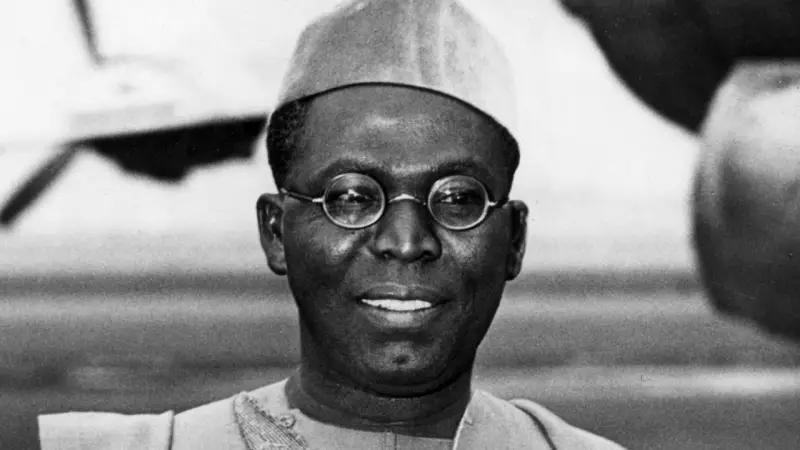
Chief Obafemi Awolowo, the revered Nigerian statesman, was far more than a political leader. A new analysis positions him as a secular prophet whose precise predictions, particularly those made during his 1963 treason trial, have eerily shaped the nation's destiny. His intellectual depth and moral vision continue to offer lessons for contemporary Nigeria.
The Prophetic Meaning in Awo's Names
Born Jeremiah Obafemi Oyeniyi Awolowo on March 6, 1909, his life unfolded as a testament to the meanings embedded in his names. Jeremiah, meaning "God will uplift," mirrored the Biblical prophet, and Awolowo was indeed exalted, becoming a premier and a foundational thinker. His name Obafemi, "the king loves me," spoke to his extraordinary charisma and the deep affection he commanded from masses and elites alike. This was encapsulated when Biafran leader Chukwuemeka Odumegwu Ojukwu called him "the best president that Nigeria never had." His name Oyeniyi, "chieftaincy title is esteemed," foreshadowed a life adorned with honours, culminating in the award of Nigeria's highest national honour, the GCFR, by his political rival President Shehu Shagari in 1982.
The 1963 Allocutus: A Blueprint for Nigeria's Future
Awolowo's formal statement before his sentencing in 1963 stands as a monumental document of foresight. It was not merely a defence but a series of prophetic declarations about Nigeria's trajectory.
He accurately predicted "the breaking up of the Northern Region into more states." This vision materialised on May 5, 1967, when General Yakubu Gowon created 12 states, fracturing the monolithic North into six units. Today's Nigeria, with 36 states, affirms his push for a more balanced federation.
On the cost of his imprisonment, Awolowo warned, "My imprisonment might do harm to Nigeria… the invaluable services which I can still render would be lost to the country." His absence created a palpable vacuum. Yet, upon his release and pardon by Lt. Colonel Yakubu Gowon on August 2, 1966, he swiftly returned to national service as Vice Chairman of the Federal Executive Council and Commissioner for Finance, fulfilling his own prediction that he would not die in prison.
He foresaw a "heightening of the present tension… which has done incalculable injury to the economy." This tension indeed escalated into violent unrest, culminating in the deadly Operation Wetie political violence in the Western Region.
Perhaps his most chilling prediction was about democracy: "For some time to come, the present twilight of democracy… will change… into one of utter darkness." On January 15, 1966, a military coup ended Nigeria's First Republic, plunging the nation into prolonged military rule, exactly as he had foreseen. Yet, he also prophesied hope: "But after darkness… comes a glorious dawn," a dawn he personally witnessed with his release and return to government.
Awo's Enduring Prophetic Legacy
Beyond the 1963 allocutus, Awolowo's speeches and writings revealed a profound understanding of Nigeria's challenges. He warned of the dangers of prolonged military rule, the necessity of true federalism, the mismanagement of oil wealth, and the catastrophic consequences of neglecting education. He argued that corruption would remain endemic unless governance was viewed as service.
His predictions often proved uncomfortably accurate. In a 1981 letter to President Shehu Shagari, he warned that "Our ship of state is fast approaching a huge rock… unless steered away, it will hit with an unspeakable disaster." Just seven months later, Nigeria plunged into a severe economic austerity, validating his economic foresight.
In a stunning long-term prediction, Awolowo stated in 1978 that an Ijaw man would one day rule Nigeria. Against all odds, this came to pass in 2010 when Goodluck Jonathan, an Ijaw man, assumed the presidency.
He even foresaw his own passing. During his 78th birthday celebration on March 6, 1987, he remarked, "What I am celebrating is actually the imminence of my transition to eternal life." He died sixty-three days later, on May 9, 1987.
Awolowo's legacy, encapsulated in his political philosophy of Awoism, endures in Nigeria's institutions and the continued reverence for his ideas. As scholar Dr. Bode Babatunde argued at the November 2025 London launch of his book Moving Nigeria Forward: Critical Perspectives on Awo's Topical Prophecies, Awolowo remains a towering figure—a moral compass and a visionary whose prophetic insights continue to challenge and guide the nation.