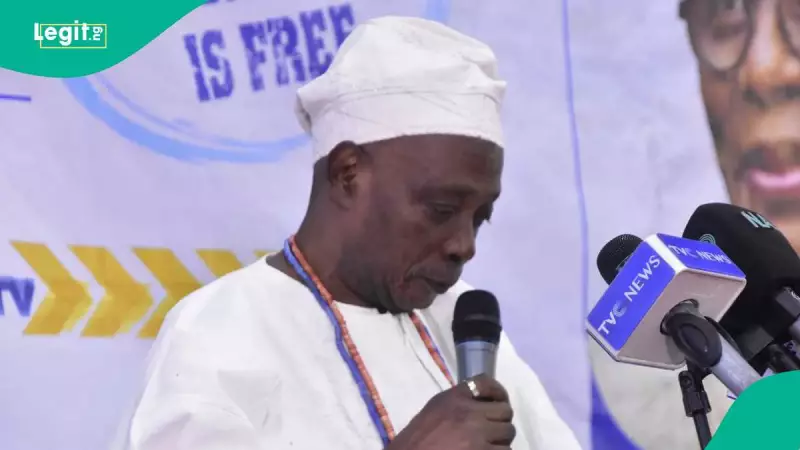
Olubadan Declares Nigeria's Fourth Republic a Failure in Key Democratic Areas
The Olubadan of Ibadanland, Oba Rashidi Ladoja, has delivered a scathing assessment of Nigeria's Fourth Republic, stating unequivocally that it has failed to deliver essential democratic dividends to the Nigerian people. Speaking at the 23rd Annual Trust Dialogue held at the Nigerian Air Force Conference Centre in Kado, Abuja, the respected traditional ruler pinpointed three critical areas where the republic has fallen short: education, the rule of law, and national security.
Education Crisis Despite Decades of Democracy
Oba Ladoja expressed profound concern over the persistent education crisis in Nigeria, questioning why, after 26 years of uninterrupted democratic rule, the government has not made education a guaranteed right for all citizens. "Government has not made education a guaranteed right. Today, many of our children are out of school. Should that be happening in Nigeria today? Can we not guarantee education for all our children?" he asked rhetorically during his address.
The monarch warned that this educational deficit poses serious dangers to Nigeria's future development, emphasizing that no society can achieve sustainable growth while denying large segments of its youth access to quality education. His remarks highlight a troubling contradiction between Nigeria's democratic longevity and its failure to provide basic educational opportunities.
Rule of Law Under Threat from Legal Uncertainty
Beyond education, Oba Ladoja raised serious concerns about the state of the rule of law in Nigeria. He cited inconsistent interpretation and application of laws as factors that significantly undermine justice and accountability throughout the country. "I have spoken to lawyers who say we cannot even guarantee what the law says, because today's interpretation may be different tomorrow. That uncertainty weakens the rule of law," the traditional ruler explained.
This legal ambiguity, according to the Olubadan, creates an environment where citizens cannot rely on consistent application of justice, thereby eroding public trust in democratic institutions and processes.
Security Challenges and Governance Reforms
The monarch also addressed Nigeria's ongoing security crisis, pointing to disturbing cases where citizens have been accidentally killed by law enforcement agents. He further highlighted complaints from security personnel themselves, who report that criminal groups often possess better equipment than those tasked with maintaining law and order.
To address these systemic failures, Oba Ladoja called for sustained constitutional and legal reforms, arguing that Nigeria must continuously amend its laws until they genuinely serve the needs and welfare of the people. He emphasized that lawmaking should not be limited to the National Assembly alone, noting that state houses of assembly and local governments also possess constitutional powers to enact laws that can improve citizens' lives.
Unrealized Democratic Potential
Despite Nigeria's 26 years of uninterrupted civil rule, Oba Ladoja noted that the full potential of the Fourth Republic remains largely unrealized due to persistent governance, economic, and security challenges. He stressed that Nigeria must confront these issues head-on if the country is to build a democratic system that truly reflects the dreams and aspirations of its people.
The traditional ruler's remarks at the Trust Dialogue represent a significant critique from a respected cultural leader, highlighting the growing concern among various segments of Nigerian society about the democratic project's shortcomings. His call for comprehensive reforms in education, legal systems, and security apparatus underscores the urgent need for Nigeria to address these fundamental issues to strengthen its democracy and improve citizens' welfare.