Nigerian Teacher's Viral Post Highlights Student's Illegible Handwriting
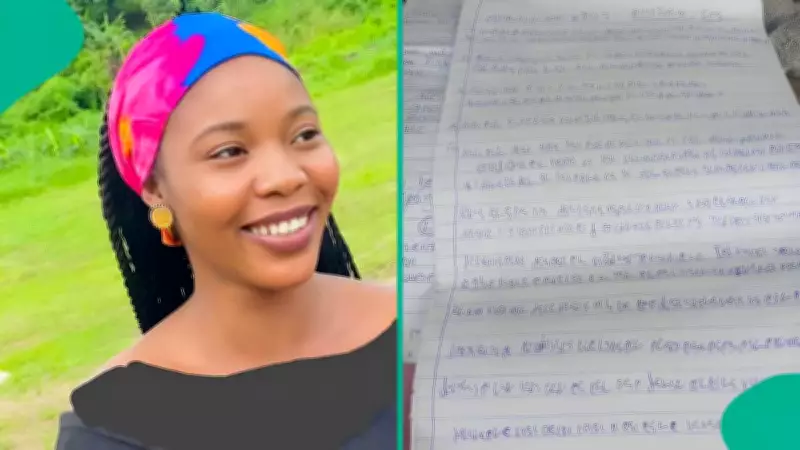
A Nigerian teacher has taken to social media to express her frustration after marking the script of a Junior Secondary School 3 (JSS3) student, whose handwriting she described as causing her a headache. The educator, who teaches social studies, shared a photo of the student's work on her X account, lamenting the difficulty she faced in deciphering the content.
Teacher's Struggle with Marking the Script
The teacher, using the handle @Aderonke, posted the image alongside a caption that detailed her stressful experience. She stated that the handwriting was so poor and unclear that it almost seemed to belong to a different subject, such as Arabic, rather than social studies. In her words, "See jss3 student handwriting ehn. Make I no just craze this period. Sha collect 5marks and go u self don try. Headache wan finish me. Why is everyone asking me if the subject is Arabic. This is social studies."
The photo quickly gained traction on the platform, drawing attention from numerous users who engaged with the post. The teacher emphasized that marking the script became an exhausting task due to the student's extremely disorganized and difficult-to-interpret penmanship.
Social Media Reactions and Diverse Opinions
The post attracted a flood of comments from Nigerians, with reactions ranging from sympathy to humor and practical advice. Many users sympathized with the teacher, agreeing that illegible handwriting can make grading a challenging and time-consuming process. Others joked about the difficulty of reading the script, highlighting the broader issue of handwriting standards in education.
One user, Franklin, offered a thoughtful perspective, suggesting that the student might be struggling with dysgraphia, a learning difficulty that affects writing skills. He explained, "Some students struggle with dysgraphia; difficulty with writing, just like others have dyslexia; difficulty in reading. It affects how letters are formed, spacing, and overall clarity, even when they understand the work. You can help the student by slowing down his/her writing, practicing letter formation regularly, using guided lines or wider spacing while writing and giving extra time for written tasks. Not every messy script is carelessness. Sometimes, it’s a learning difficulty that needs patience, not punishment."
Other comments included:
- Monisola wrote: "Wait fess public school or private school then I will proceed with why."
- Nnem reacted: "Is this English? I can't read anything. Advice the student to learn handwriting with that handwriting 20 leaves, he/she will definitely improve."
- Mosafejo added: "Same jss3, Mrs Oguntoye told about 6 of us with bad handwriting to buy 2a and 2b or 2d (the one for handwriting) I can’t say it made my handwriting better but it helped one of us. You can do the same to him or her."
Broader Context and Related Incidents
This incident is not isolated, as similar cases have been reported in the past. For instance, Legit.ng previously covered a story where a Nigerian lady shared a handwritten note from her roommate, a 200-level medicine and surgery student, which was also described as terrible. Such occurrences highlight ongoing concerns about handwriting quality among students at various educational levels in Nigeria.
The viral post has sparked a broader conversation about the challenges teachers face in assessing written work and the potential underlying issues students may have, such as learning disabilities. It also raises questions about how educators can support students in improving their handwriting skills without resorting to punishment.
As the discussion continues online, it underscores the importance of addressing handwriting difficulties in schools to ensure effective communication and learning outcomes. The teacher's experience serves as a reminder of the need for patience and understanding in educational settings, particularly when dealing with students who may be struggling with basic skills.