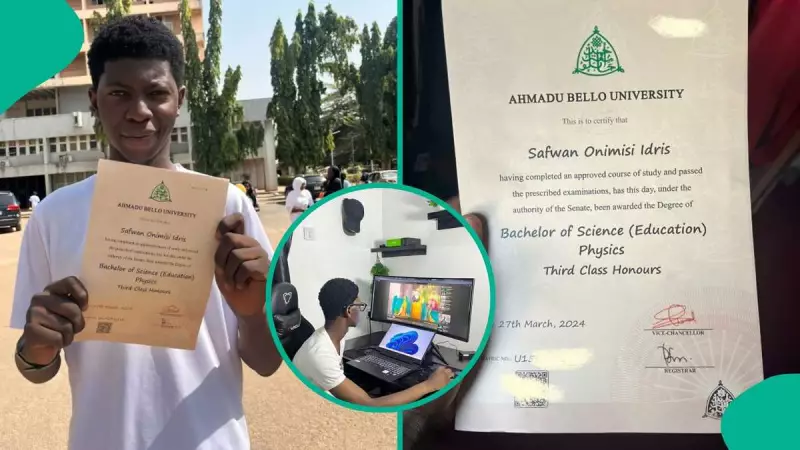
Third-Class ABU Graduate Shares Career Milestones Amid Academic Achievement Debate
A Nigerian man who previously gained attention online for revealing his third-class degree from Ahmadu Bello University (ABU), Zaria, has provided a significant update on his professional journey, demonstrating that academic classification does not necessarily determine career trajectory.
From Viral Academic Disclosure to Professional Achievement
Safwan Idris, the graduate in question, initially shared a screenshot of his academic result which sparked widespread discussion across social media platforms. While some users commended his transparency regarding his educational background, others expressed skepticism about the value of a third-class degree in today's competitive job market.
The conversation took an interesting turn when one commenter, identified as King Godson, dismissed the achievement entirely, stating that "third class isn't worth celebrating bro" and warning that such academic performance could create employment challenges in the future.
Professional Response to Academic Critics
In a compelling response to his critics, Idris revealed substantial professional accomplishments that contradict the notion that his academic classification would limit his career prospects. He disclosed that he currently serves as Lead Brand Designer at Safari Sports, a position of significant responsibility in the creative industry.
Furthermore, the graduate demonstrated entrepreneurial initiative by establishing and operating his own design agency called Rezollute. His response to critics included a notable statement: "I'd rather hire you to work on any large gig I secure," suggesting that his professional capabilities extend beyond his academic record.
Mixed Social Media Reactions to Career Update
The graduate's career update generated diverse reactions from social media users, reflecting broader societal debates about education versus practical skills:
- @Ade_Dero acknowledged the achievement while maintaining that "a 3rd class is not worth celebrating" and suggested greater academic effort could have yielded better results
- @godpower002 questioned whether professional opportunities resulted from academic credentials or social media influence
- @codewithfreddev dismissed certificate-focused criticism with the comment "No mind the werey him think say nah by certificate"
- @copymegabyte shared personal experience of relying on acquired skills despite strong academic performance
- @tslasheikh reinforced the perspective that success transcends academic classification, citing employment in a top federal agency with a pass degree
Additional Career Opportunities Emerge
Beyond his current professional roles, Idris reportedly received a tempting relocation offer from an individual identified as @qroniqls on social media platform X. The proposition suggested potential sponsorship for relocation to the United Kingdom, indicating that his story and achievements have attracted attention beyond national borders.
This development adds another layer to the narrative of how professional capability and personal branding can create opportunities that transcend traditional academic pathways.
Broader Implications for Educational Perspectives
The ongoing discussion surrounding Idris's career progression highlights evolving attitudes toward academic achievement in contemporary Nigerian society. While traditional emphasis on first-class and second-class degrees remains prevalent in certain sectors, this case demonstrates increasing recognition of practical skills, entrepreneurial initiative, and professional competence as complementary or alternative pathways to success.
The conversation continues to challenge conventional wisdom about the relationship between academic performance and career achievement, particularly in creative and entrepreneurial fields where demonstrated capability often carries more weight than formal credentials.