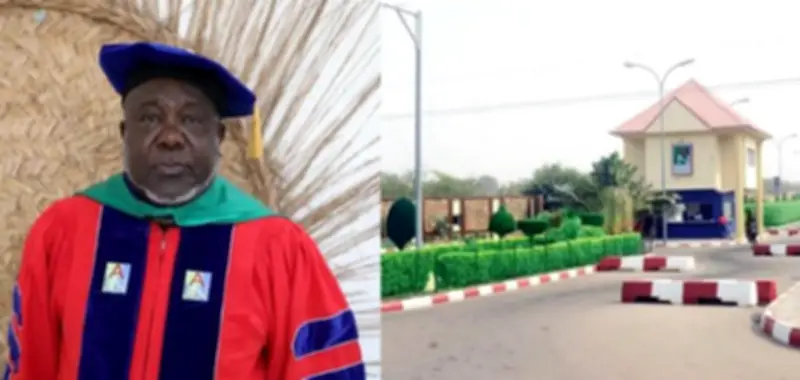
The American University of Nigeria (AUN) in Yola has suspended the Dean of its School of Law, Bello Magaji, following a PREMIUM TIMES investigation into how the former military officer avoided serving a prison sentence for sodomy despite his conviction being upheld by Nigeria's highest court.
Suspension Announcement
The university announced Mr. Magaji's suspension in a statement released on Monday by its registrar, Daniel Okereke. According to the statement, Mr. Magaji, an associate professor, has been placed on indefinite leave without pay pending the outcome of an administrative review by a panel constituted by the university management.
AUN stated that the decision was prompted by the discovery of Mr. Magaji's non-disclosure of prior military service and misrepresentation of records in the university's employee records at the time of employment. The institution emphasized that these actions constitute a fundamental breach of trust and are considered matters of serious concern.
The university reiterated its commitment to upholding the highest standards of integrity, transparency, and accountability in all its operations.
How Magaji Avoided Jail Despite Conviction
PREMIUM TIMES reported on Sunday how Mr. Magaji, a former military police officer in the Nigerian Army convicted of sodomy by a General Court Martial (GCM), never served his prison sentence despite the Supreme Court upholding the conviction.
In 1997, the military court sentenced him to seven years' imprisonment, later reduced to five years, after finding him guilty of sodomy with four boys, including a 17-year-old. According to court documents, two victims and one witness testified that he had intoxicated them with alcohol before having carnal knowledge of them in 1996.
Mr. Magaji maintained his innocence and claimed he was framed for prosecuting cases as a military police officer. He pursued the case through Nigeria's court hierarchies, from the General Court Martial to the Court of Appeal, the Supreme Court, the National Human Rights Commission (NHRC), and the Human Rights Violations Investigation Commission (HRVIC), also known as the Oputa Panel, established in 1999 by then-President Olusegun Obasanjo upon Nigeria's transition to civil rule.
In 2008, the Supreme Court upheld the 1997 conviction. Yet, Mr. Magaji never served his time. Instead, former President Goodluck Jonathan granted him a presidential pardon five years later in 2013. The Nigerian Army also altered Mr. Magaji's official records, replacing his dismissal from service with a voluntary retirement.
Following his exit from the military, Mr. Magaji built an academic career, holding senior positions in Nigerian universities, including serving as dean of law faculties.