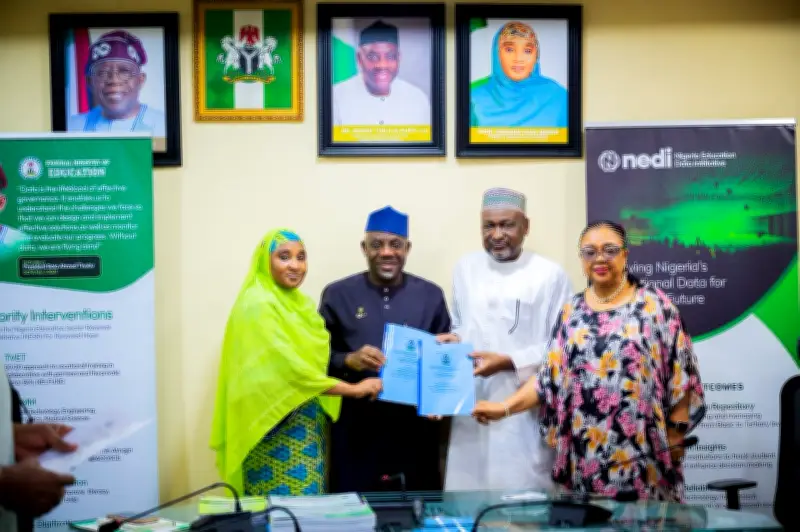
The Federal Government has adopted an 80 per cent practical training model for agriculture-related programmes in Polytechnics and Colleges of Education, a move aimed at equipping Nigerian youths with relevant skills and strengthening the agricultural sector. The Minister of Education, Dr. Maruf Tunji Alausa, disclosed this on Thursday while receiving the report of the committee responsible for implementing the reviewed agriculture curricula for Polytechnics and Colleges of Education.
Shift from Theoretical to Practical Training
Alausa said the reform reflected the commitment of President Bola Ahmed Tinubu’s administration to reposition agriculture as a skills-driven sector capable of creating productive opportunities for young Nigerians and contributing to economic growth. He described the shift from the former 70 per cent theoretical and 30 per cent practical structure to 80 per cent practical and 20 per cent theoretical training as a major step towards producing graduates with hands-on competencies required by the agricultural industry.
According to him, the revised curricula are designed to move agricultural education beyond classroom instruction by giving students practical experience that can be applied directly to farming, agribusiness and other areas of the agricultural value chain. The minister expressed optimism that the new approach would produce a better-trained workforce, strengthen capacity in the sector and help translate education and skills acquisition into productive economic activities.
Objectives and Stakeholder Support
Alausa said the ultimate objective was to ensure that Nigerian youths acquired practical competencies that would enable them to become productive participants in the agricultural sector rather than merely obtain academic qualifications. He called for the comprehensive rollout of the reviewed curricula and urged stakeholders, including industry players, academics, teachers and institutions, to support the implementation process.
The minister also stressed the need for effective sensitisation of stakeholders on the rationale behind the reforms, as well as adequate training of teachers and provision of the necessary facilities and other support required for institutions to deliver the new curricula effectively. Earlier, the Minister of State for Education, Prof. Suwaiba Sa’id Ahmad, commended members of the committee for their commitment to the curriculum review.
Committee Contributions and New Curricula
Ahmad acknowledged the contributions of the National Board for Technical Education (NBTE), Skills Council, industry representatives and academics, saying their collaboration strengthened the review process and enriched the resulting curricula. She expressed confidence that the revised curricula would produce measurable improvements in agricultural skills development, stressing the importance of engaging stakeholders and the general public to deepen understanding and acceptance of the reforms.
Presenting the committee’s report, the Executive Secretary of NBTE, Prof. Idris Muhammad Bugaje, said the exercise produced 36 new and reviewed National Diploma (ND) and Higher National Diploma (HND) curricula, three National Certificate in Education (NCE) curricula and 31 National Occupational Standards. Bugaje explained that 27 of the National Occupational Standards were newly developed, while four existing standards were reviewed, thereby expanding the framework for skills development in agriculture.
He said the assignment had been completed and that the resulting documents had been considered and approved by the relevant regulatory bodies, including the Board and Commission. The NBTE executive secretary added that the complete set of reviewed curricula would be formally unveiled at a later public event, describing the outcome of the exercise as a significant boost to agricultural skills development.
Implementation and Future Outlook
Alausa assured that the Federal Ministry of Education would collaborate with NBTE, educational institutions, industry stakeholders and other relevant bodies to ensure effective implementation of the reviewed curricula. He said the government would remain focused on equipping young Nigerians with practical skills, strengthening agricultural capacity and converting the country’s vast agricultural potential into productive opportunities in line with the Renewed Hope Agenda of the Tinubu administration.