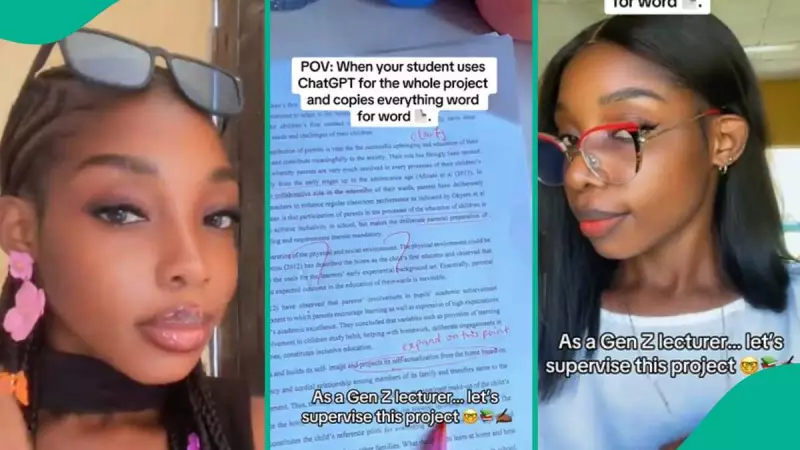
A Nigerian lecturer has sparked widespread discussion online after sharing a video detailing how she penalized a student for submitting a project entirely written by artificial intelligence (AI). The incident, which occurred in early December 2025, highlights the growing tension between emerging technology and academic integrity in Nigerian universities.
The Viral Video and the Lecturer's Stance
The lecturer, who goes by the TikTok handle @shadesoflisa, posted a video showing her assessment of a student's project work. In the clip, she explained that from her evaluation, it was clear the student did not write the assignment themselves but relied completely on an AI tool like ChatGPT.
Lisa, the Gen Z lecturer, stated that using AI to compose an entire project is not permissible. She emphasized that while AI is a valuable tool, it must be used with caution and intelligence in an academic setting. Her core message was that students should treat AI as a reference point for research and ideas, not as a ghostwriter.
"ChatGPT is fine to use, but not word for word. Treat it as a reference, not your full project," she advised in the video. As a consequence for what she deemed a failure to use AI smartly, the lecturer took the severe step of cancelling the entire project work. She instructed the student to redo the assignment from scratch.
Social Media Reactions: Support, Questions, and Alternatives
The video quickly went viral, attracting a flood of comments from social media users with diverse opinions on the matter. Many expressed concern over the declining intellectual effort among students.
Some users questioned how the lecturer was so certain the work was AI-generated. Others shared their own experiences, with one commenter, @mhunauwharah, recalling: "Na so my project supervisor did to me when I was copying from Google until I got tired and start copying from previous projects from library."
A number of reactions focused on the methodology of the penalty itself. User @Sadiq Usman Omotizi critiqued the approach, suggesting more modern, pedagogical methods: "Why are we still wasting paper in 2025? If you are a Genz lecturer, use digital tools. 'Track Changes' on MS exists for a reason... Guide students with logical comments, not just lines and question marks."
Several commentators offered practical advice for using AI correctly. @thedigital_advocate noted, "Using ChatGPT requires you prompting it well and then being smart with it. Don't just copy and paste, make research on that topic and paraphrase." Another user, @Lovely, even humorously offered to tutor the penalized student on the proper use of the technology.
The Broader Context: AI, Education, and Academic Standards
This incident is not isolated. It reflects a global challenge educators face with the proliferation of accessible AI writing tools. The lecturer's action underscores a critical debate in educational circles: where should the line be drawn between using technology as an aid and outsourcing the core learning process?
The key takeaway from the lecturer's message is the distinction between misuse and smart use. She penalized the student not for accessing technology, but for the lazy and academically dishonest application of it—submitting AI-generated text verbatim without original thought, analysis, or personal effort.
This event serves as a stark reminder to students across Nigerian institutions that while technological adoption is inevitable, fundamental academic principles of originality, critical thinking, and personal effort remain paramount. It also pushes educators to clearly define and communicate policies on AI use to prevent such conflicts and guide students toward ethical and productive engagement with new tools.