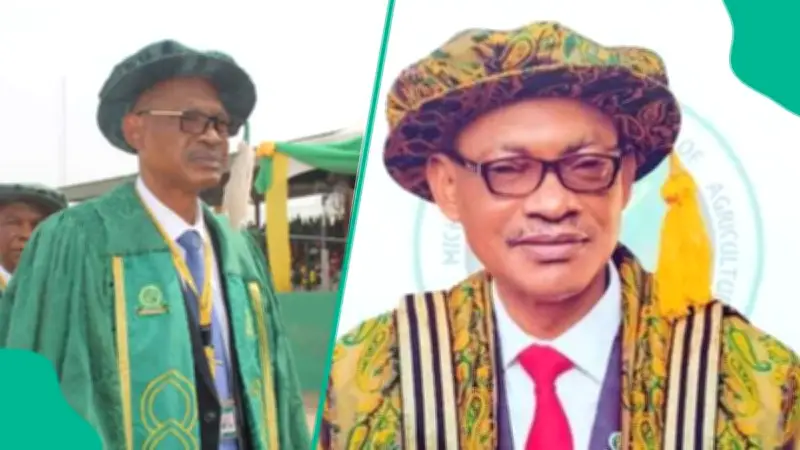
The recent mass staff disengagement at Michael Okpara University of Agriculture, Umudike (MOUAU) has sparked intense debate, but a closer look at Prof. Maduebibisi Ofo Iwe's five-year tenure reveals a complex legacy of transformation and controversy. As the university community grapples with the fallout, the question remains: should leadership be judged by the turbulence of the moment or by the enduring impact of reforms?
The Recruitment Controversy and Staff Disengagement
At the heart of the public outcry is the termination of 127 staff members recruited during the university's last employment exercise. According to a ThisDay newspaper report, the Federal Government approved the recruitment of 426 personnel, but appointment letters were reportedly issued to 618 applicants, with 553 eventually captured on the Government Integrated Financial Management Information System (GIFMIS). This discrepancy has fueled scrutiny and differing interpretations of the recruitment process.
Prof. Iwe, however, has defended his administration's actions, arguing that university administration requires balancing the interests of government regulators, governing councils, academic unions, students, alumni, host communities, development partners, and political stakeholders—whose expectations often intersect and sometimes conflict. He alleged that some applicants later discovered that names different from those originally shortlisted had appeared in their place.
"Many applicants saw their names during the process but later discovered that their names had been substituted," Iwe said. "As my administration was winding down, it became difficult to determine how those changes occurred. I expected the incoming administration to investigate and correct any anomalies because university administration is a continuum."
TETFund Intervention and the Zinox Technology Deal
Another contentious issue involves the utilisation of the 2026 intervention funds from the Tertiary Education Trust Fund (TETFund). Iwe explained that the university had long struggled with obsolete printing and copying equipment used for producing sensitive documents, including examination materials. To address this, the university entered into an agreement with Zinox Technologies to replace outdated equipment with modern, high-capacity digital machines.
According to Iwe, the institution obtained TETFund approval for a virement to finance the project once the intervention funds were released. "We secured TETFund approval for the virement, and when the intervention funds amounting to over ₦2 billion were received, they were applied to that purpose in accordance with the approval," he stated. "I have since been informed that the project has been discontinued by the new administration." This has raised questions about why a project with such transformative potential was abandoned even when funding was available.
Prof. Iwe's Academic and Administrative Credentials
Prof. Iwe's credentials are not in doubt. He is a distinguished academic, author, and Professor of Food Science and Extrusion Technology, as well as an Internationally Certified Food Scientist (CFS). He currently serves as the National President of the Nigerian Institute of Food Science and Technology (NIFST).
During his tenure, which ran from March 1, 2021, to February 28, 2026, he oversaw several transformative projects, including moving the institution from its temporary site to the permanent site, initiating the construction of a new Senate Building, an ICT Centre, a Physical Planning Building, and a 500-seat lecture theatre. He also expanded the guest house to a 25-room facility, constructed another 51-room facility, provided 24-hour electricity to the campus, and built bread and water factories to enhance internally generated revenue.
Relocation to the Permanent Site and Global Recognition
Perhaps no other achievement better captures Iwe's administration than the relocation of the university to its permanent site. Although previous administrations had secured the Federal Ministry of Education's approval for the move, Iwe oversaw its implementation, successfully acquiring its Certificate of Occupancy. This laid the foundation for a purpose-built agricultural university with modern facilities and expansive farmland capable of supporting innovation in food security, agribusiness, and agricultural research.
Under his leadership, MOUAU also made its first appearance in the Times Higher Education (THE) Impact Rankings for Sustainability in 2026, placing in the 1001–1500 band out of 1,646 universities from 116 countries. The certificate was received at the 2026 Global Sustainable Development Congress in Jakarta, Indonesia, making MOUAU the only one among Nigeria's five Federal Universities of Agriculture to earn this recognition.
Controversies and Strained Transition
Despite these achievements, Iwe's tenure was not without controversy. As his administration drew to a close, disagreements between the Vice-Chancellor and sections of the Governing Council became increasingly public. Notably, the Pro-Chancellor and Chairman of Council, Comrade Fidelis Ede, was absent during Iwe's valedictory lecture, fueling speculation about strained relations.
The recruitment exercise conducted during the closing months of his administration has remained a point of contention. The Pro-Chancellor maintained that internal stakeholders were not involved in aspects of the exercise, alleging that the former Vice-Chancellor acted alone. Iwe, however, has consistently maintained that any irregularities should be investigated objectively and resolved through established administrative procedures.
Broader Implications for Abia State and Higher Education
The controversies at MOUAU have prompted wider conversations about academic leadership, institutional stability, and the need to protect universities from excessive politicisation. Stakeholders argue that the focus should remain on preserving institutional memory and ensuring that successive administrations build upon the achievements of their predecessors.
Beyond MOUAU, indigenes of Abia State have expressed concern about the underrepresentation of the state in the leadership of federal universities. Of all the federal universities in Nigeria, none currently has an Abia State indigene as Vice-Chancellor. Among the eight federal universities in the South East, four Vice-Chancellors are from Imo State, two from Ebonyi, and two from Enugu. MOUAU has produced seven Vice-Chancellors, with Prof. O.C. Onwudike and Prof. Emebesi Iwe being the only ones from Abia State.
This underrepresentation reinforces the importance of merit and institutional excellence in university governance, rather than mere politics. As MOUAU enters a new chapter, the responsibility rests with its Governing Council, management, staff, students, alumni, and other stakeholders to preserve what has been achieved and ensure that institutional progress is never sacrificed to transient divisions.
Ultimately, every Vice-Chancellor leaves office with two reports: one written immediately by supporters and critics, shaped by emotion and politics, and another written quietly by history, informed by evidence and institutional outcomes. For Prof. Iwe, history may well judge him by the foundations he laid for a more competitive and globally recognised MOUAU.